
Search
Theology Day draws religion teachers, chaplains for OSV presentation
-
 October 30, 2025By RENEE WEBB
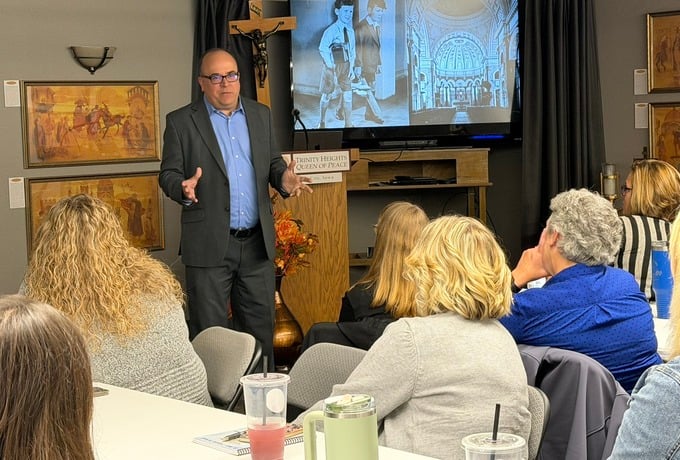
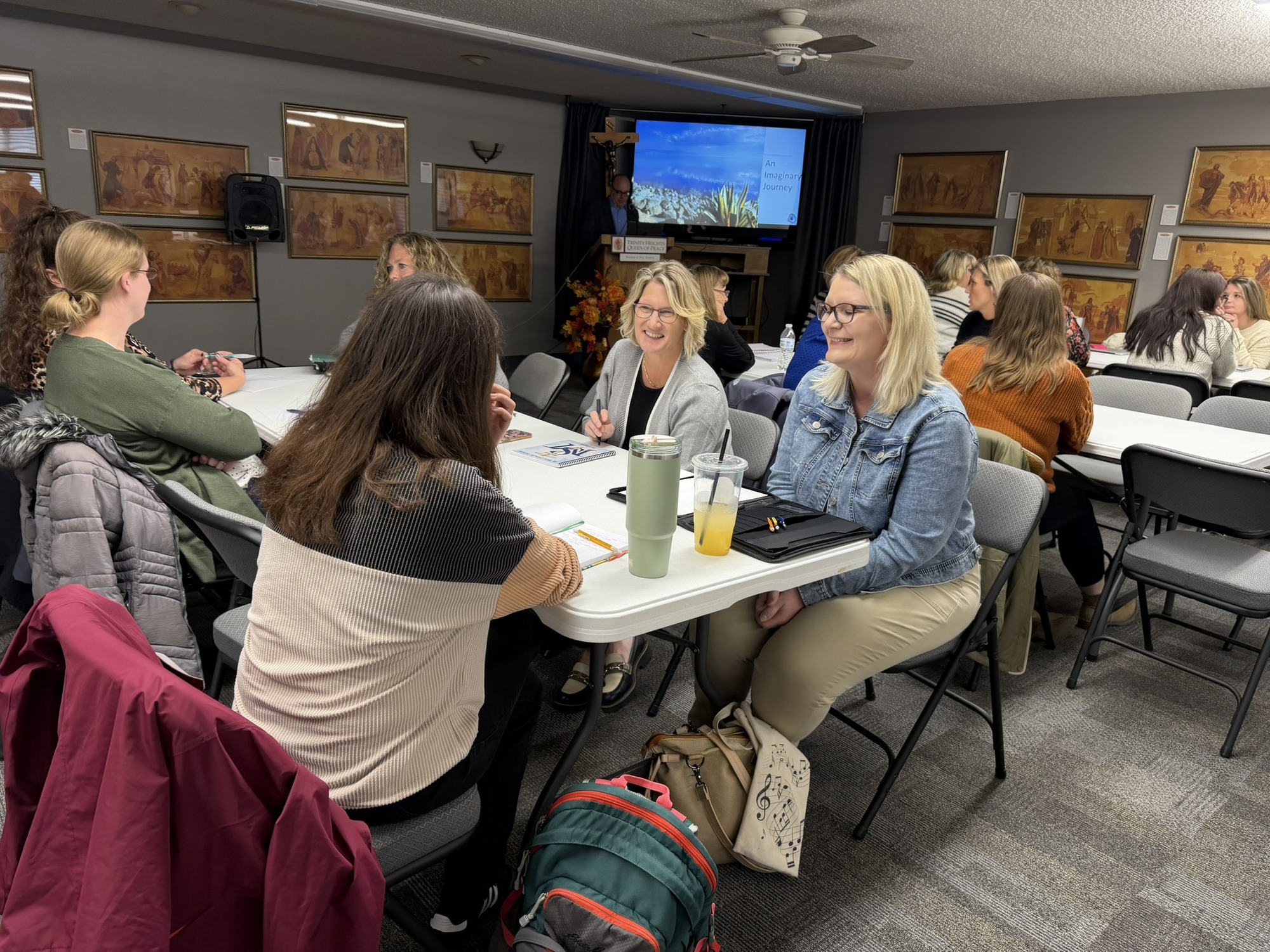
Content and Design CoordinatorCatholic school religion teachers, school chaplains and administrators attended a Theology Day Oct. 28 to receive some personal enrichment and tips to help form students in the faith.Sponsored by the Catholic Schools Office, Kelly Kohout said this is the second year their office has offered a day of professional development for those who work in religion/theology in the diocesan schools. The educators in this field had requested it as these types of development days are offered in other subject areas.“Last year people really appreciated getting together to pray together and learn together,” said the director of education services for the diocese. “Some of the smaller schools do not have the opportunity to collaborate and connect over this subject area.”This gathering was an optional event. About 50 attended, representing eight of the 15 Catholic school systems in the diocese.Facilitator of the day was Joseph White, Ph.D., associate publisher for catechetical resources at Our Sunday Visitor. He is an author of various catechetical books/materials and has a background in child psychology.Kohout had previously met and worked with Dr. White as part of ACRE (Assessment of Children/Youth Religious Education). In addition to two sessions offered by White, Hannah Effertz with OSV was on hand to share a variety of religion resources and curriculum.God revealing himselfDuring the morning session, the speaker asked the participants to reflect on how God tells the people about himself. He used personal stories and humor to convey the many ways the Lord reveals himself and acknowledged that his examples were just some of the ways God does so.In Matthew 25, White noted that Jesus said whatever you do for the least of these, you’ve done for me.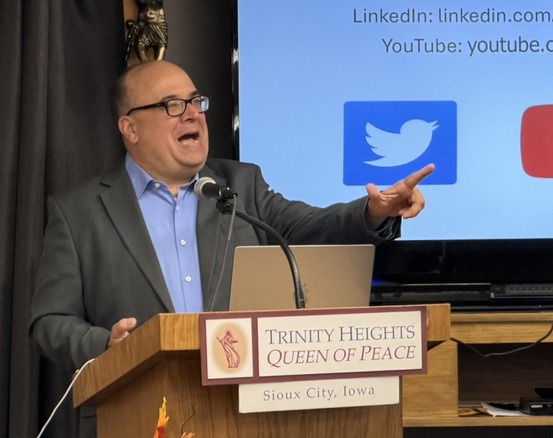 “Scripture does tell us that we always want to be kind and charitable because we could be entertaining angels,” he said, sharing a story about a friend’s possible divine encounter while sharing a meal with a homeless person.White reminded them that as educators they offer works of mercy on a daily basis – especially those who are parents.“How many of you in your work as parents have ever given food to the hungry? Like three times a day plus snacks. How many of you have given drink to the thirsty – even when it’s the middle of the night and you are not sure they are really thirsty but wanted to get up again,” said White.He told them not to discount the everyday experiences because they are opportunities to encounter God and get to know him.“God speaks to us through people in need. Another way God speaks to us is through the gifts and talents he has given us,” said White, who mentioned that these talents shed insights into how God is calling them. “I know many of you – because you are here – have gifts in the area of working with kids. It’s great you are using your talents in a Catholic school, that’s amazing.”The facilitator offered various examples of ways that God speaks to the people – through art, humor, nature, architecture, music, movies and more.As the morning session drew to a close, White led the educators through a modified form of lectio divina and Ignatian reflection where they placed themselves in another time and place and reflected upon Scripture related to the fishers of men. They discerned what God was trying to tell them.He told them a series offered by OSV was Alive in Christ and every lesson for the first to eighth graders starts with a process of Scripture reflection that allows them to listen for what God is saying to them.“From there, we go to what questions do you have about this,” said White. “How many of you get excited for learning something that you have no questions about at all. Very often with kids, that’s what we do. We give them a lot of information before they have any questions.”Curiosity, he stressed, is what drives learning.Common questionsIn the afternoon session, White addressed common and pressing questions that teachers had about forming students in the faith.He looked at how you present the Good News of Christ in a predominately post-Christian
 society. “There’s this understanding that things have changed in the United States in a couple of generations in that people don’t go to church as much as they use to. Even though those families in your schools might be Catholic, they might not be weekly Mass attenders,” acknowledged White. “Or even if they go to Mass, they live in a secular society and are surrounded by messages that compete.”Ultimately, White reminded the educators that students - like all people - want to know: Who am I, why am I here and what’s it all for?“Our faith gives not only answers to those questions, but the only fully satisfying answers,” he said. “Those answers are found in the proclamation of the core value of the Gospel, the kerygma.”In an apostolic exhortation for young people and those who work with young people, Pope Francis had summarized the kerygma: God loves you. Christ is your savior. Christ is alive.“And then he (the pope) added, and he wants you to be alive with him,” said White, who cautioned the educators that priorities can get misaligned and faith grow cold so it’s important to keep coming back to the core message of the kerygma.He spoke of the role of Catholic schools in evangelizing the faith, stating the schools were uniquely designed for formation the whole person – body, mind and soul.Another common question is how to hand on a Christian vision of the human person as it becomes increasingly counter-cultural.“Understanding our own identity as beings created in the image and likeness of God created in dignity; understanding relationships, gender and other aspects of the human person in the light of God’s plan for us when the society sometimes presents a very different perspective,” he said.White pointed out that young people today actually crave objective truth as they are growing tired of confusing messages.
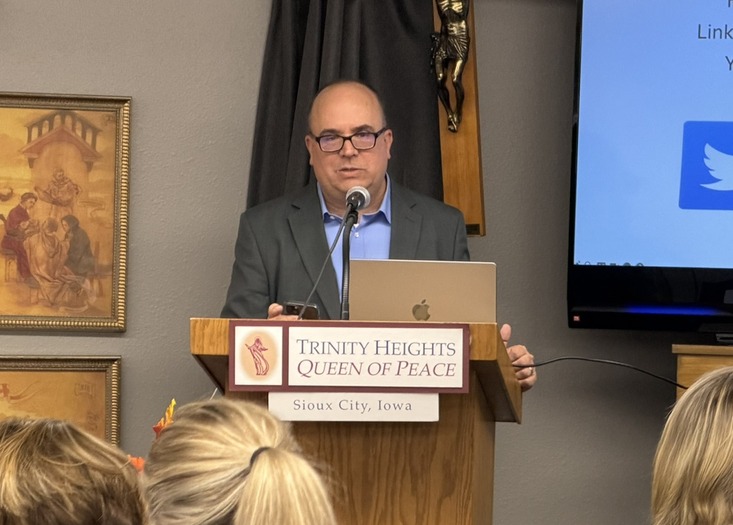 “While I think we as Catholics can do more to emphasize a personal relationship with God, a personal relationship isn’t quite enough. When Jesus sent out his disciples, he didn’t send them out one by one, he sent them two by two because he knows that we need each other,” said White. “We have to accompany one another in faith.”This can not only offer encouragement to one another but stand as a form of accountability.To help their students have a living faith, he told the educators to form them in the head, heart and hands.A third question dealt with how the growth of technology has impacted the way students think about religion and spirituality.White pointed out that the average person spends nine hours a day on screentime which can provide endless distractions from thinking about “who am I” and “what’s is all for?”He mentioned that the most recent Directory of Catechesis was promulgated in 2023 and before that it was 1997. The change in the “digital landscape” was one of the driving factors in the update.“Sometimes the most fringe opinions get magnified online, especially if you fall down the rabbit hole into the algorithm,” said White, which can create much confusion for youth.Another compelling question educators have, the speaker noted, centered on how to prepare students to live a life of discipleship and share the example of Jesus with others in word and action.To help in this effort, White said religion teachers can have conversations with students about what they have learned, help students reflect on ways to live the message and assist parents in discussing and reinforcing the message at home.Reaction to the dayErin Bohlmann, fourth grade teacher at Kuemper Catholic School in Carroll, said she valued receiving practical tips the speaker offered as well as his use of stories to illustrate lessons.“It really resonated with me,” she said. “Whenever you can attach a story to some sort of
 truth you are trying to portray I think it sticks better.” Especially in the first presentation related to encountering God in daily life, the teacher noted that White’s story application reminded her of the value of storytelling in learning.In the second session, Bohlmann said she appreciated “the framework of head, heart and hands as it is a reminder that we are not just filling students with information about Catholicism but trying to inspire their hearts and relating to the hands, putting it into practice.”Deacon Dan Goebel, religion teacher and chaplain at Gehlen Catholic School in Le Mars, also enjoyed the stories and said he will take back some things that he can put into practice at the school.The concept of focusing on head, heart and hands also stood out to him as it “helps make the faith come alive and sets the Catholic education apart.”Having used lectio divina in the past, he liked White’s adaptation on the practice as well as the concept of asking a question to build interest prior to diving into a lesson.“Teaching religion is a great ministry but as he said, you sometimes wonder if you are making a difference. It was a good affirmation that what we are doing is important along with picking up some new ideas,” said Deacon Goebel, who noted that being with other teachers was reenergizing.Kohout pointed out that the Catholic schools in the diocese are presently working on a theology standards revision.