Search
-
 April 13, 2026By RENEE WEBB
Content and Design Coordinator
“I desire that the Feast of Mercy be a refuge and shelter for all souls, and especially for poor sinners. On that day the very depths of my tender mercy are open. I pour out a whole ocean of graces upon those souls who approach the fount of my mercy.” – Jesus words to St. Faustina, recorded in St. Faustina’s Diary 699
It was St. John Paul II who in the year 2000 announced that Divine Mercy Sunday would be a universal feast of the Catholic Church to be celebrated on the second Sunday of Easter. The late pope made the proclamation during the canonization of St. Faustina Kowalska, a Polish nun who inspired the Divine Mercy devotion through her 600-page diary containing visions and revelations of Christ.
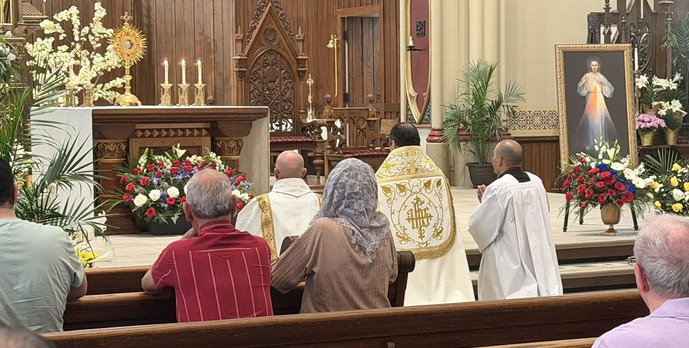
Several parishes in the Diocese of Sioux City were among those throughout the world to hold Divine Mercy Sunday celebrations on April 12 to reflect on the gift of Christ’s endless love and forgiveness.
Many of the prayer services included eucharistic adoration, confessions, the Chaplet of Divine Mercy, veneration of the Divine Mercy image and reflection.
The prayer service organized by Trinity Heights Queen of Peace Shrine in Sioux City was held at Holy Cross Parish, St. Michael Church. After 90 minutes of adoration and time for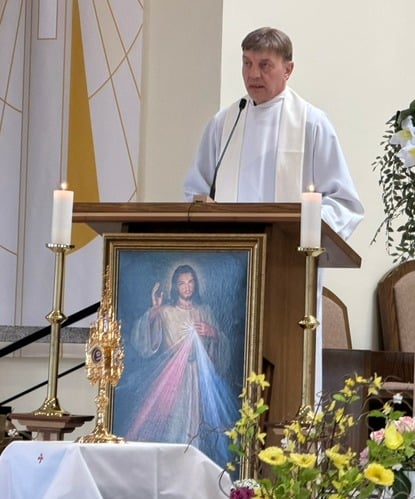 Father Randy Schon, pastor of Holy Cross Parish in Sioux City, leads Divine Mercy prayers.confession, the hour of mercy began at 3 p.m. with excerpts from the diary of St. Faustina offered by Debbie Organiscak, the chaplet sung by Jim Doyle and prayers led by Father Randy Schon, pastor.
Bishop Emeritus Walker Nickless was the guest speaker, who leaned into Pope Leo XIV’s prayers for peace, which was also a focus of the Gospel for the day when Jesus repeats to his apostles three times, “Peace be with you.”
“My brothers and sisters, all of us know how much we need the gift of peace, especially in these days,” he said. “We pray ever so intently for peace in the world. We pray for peace in our families and in the family of our nation. We are all aware of the bitter and harsh words that are so prevalent today shared in exchanges with our family members and with our fellow Americans.”
Division is everywhere, Bishop Nickless noted, attributing it to the work of the devil.
“On this Divine Mercy Sunday, we ask for mercy and promise to share that mercy with one another as we pray for Easter peace, Easter joy and Easter hope in these hard times,” he said. “We also pray for peace in our own troubled hearts. Aware of our personal sin, we beg for mercy and forgiveness.”
The bishop acknowledged human sinfulness built on selfishness, indifference to the needs of others, lust, gossip and so on which leaves hearts restless and unsettled.
“We need peace and mercy in our own hearts that only the Lord can give us,” said Bishop Nickless. “It’s so easy to lose hope. Divine Mercy is God’s gift to us.”
He closed his talk with a Consecration to the Divine Mercy that was prayed in churches that day throughout the Philippines.
“Make us instruments of consolation to others who have lost hope and do not trust in your mercy. Trust in your mercy and glorify your mercy forever and ever. Jesus, king of mercy, we trust you. We are all yours, amen,” the consecration prayer concluded.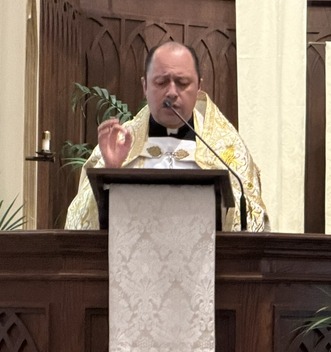 Father David Esquiliano delivers a bilingual homily in English and Spanish.A bilingual prayer service in English and Spanish was offered at Cathedral of the Epiphany in Sioux City with Father David Esquiliano, rector, leading the ceremony.
Following exposition of the Blessed Sacrament, the Gospel of John 8:1-11 was read that focused on the Pharisees bringing a woman caught in the act of adultery to Jesus. The crowd was ready to stone the woman but Jesus told them that the one among them without sin could cast the first stone. Eventually, the accusers left. No one was left to condemn her and Jesus said, “Neither do I condemn you. Go, and from now on do not sin anymore.”
In his homily, Father Esquiliano said the Scripture verse “provided a beautiful image of what happens in the confessional.”
While God does not condemn the sinner, he said that doesn’t mean sin does not matter but rather that “mercy is greater.”
Father Esquiliano pointed out that God only asks the faithful for a contrite heart.
As with most locations, the service at the Cathedral included adoration and confessions.
“Every time you go to confession, immerse yourself entirely in my mercy, with great trust, so that I may pour the bounty of my grace upon your soul. When you approach the confessional, know this, that I myself am waiting there for you. I am only hidden by the priest, but I myself act in your soul.” – Jesus words to St. Faustina, diary 1602.
HOME