
Search
Seminarians build relationships, language in Guatemala immersion
-
 July 31, 2025By DAWN PROSSER
Director of Communications
Diocesan seminarians James Fitzsimmons of Sioux City Cathedral Parish and Garrett Hugeback of Wall Lake St. Joseph Parish said they anticipated they would be asked to participate in a Spanish immersion experience at some time in their formation. The two Kenrick-Glennon Seminary students recently returned from spending six weeks in Guatemala.
Both said with the large Hispanic population in northwest Iowa, they recognized the importance of some level of mastery of Spanish as seminarians and future diocesan priests.
“Being a parishioner at the Cathedral and interacting with the Hispanic people – I want to be able to communicate with (them),” Fitzsimmons said. “When you don’t know the language it’s such a barrier there. It was a mutual desire for me and the diocese to go study Spanish.”
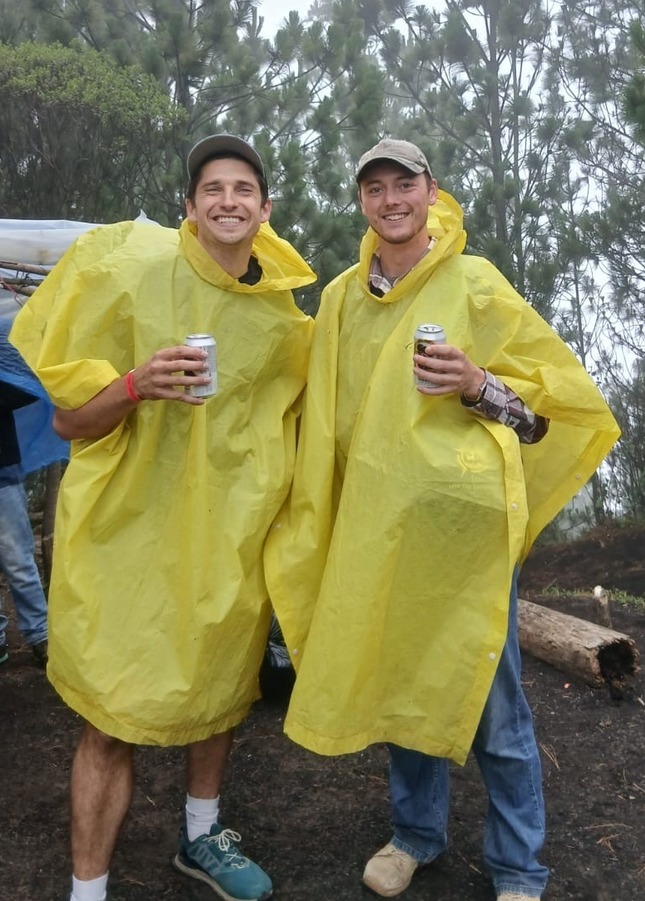 Although Fitzsimmons and Hugeback arrived in the rainy season, they still explored the area.“When Father Shane (Deman, director of seminarians), asked if I would be open to this, I said, ‘absolutely,’” Hugeback shared, noting the growing numbers of Spanish speakers in the diocese.
Both said they studied Spanish for four years in high school and another year in college, but neither felt they remembered much of the language prior to the immersion in Central America.
“I had never taken a lot of time to practice the language,” said Hugeback. “I was good with the bookwork but this was the first time I had intentionally spoken the language. I was never that confident … to speak it.”
Rough first day
The seminarians said when the arrived, they soon learned they were on their own navigating the town of Antigua with limited Spanish skills. Hugeback described their Spanish as “rusty to say the least.”
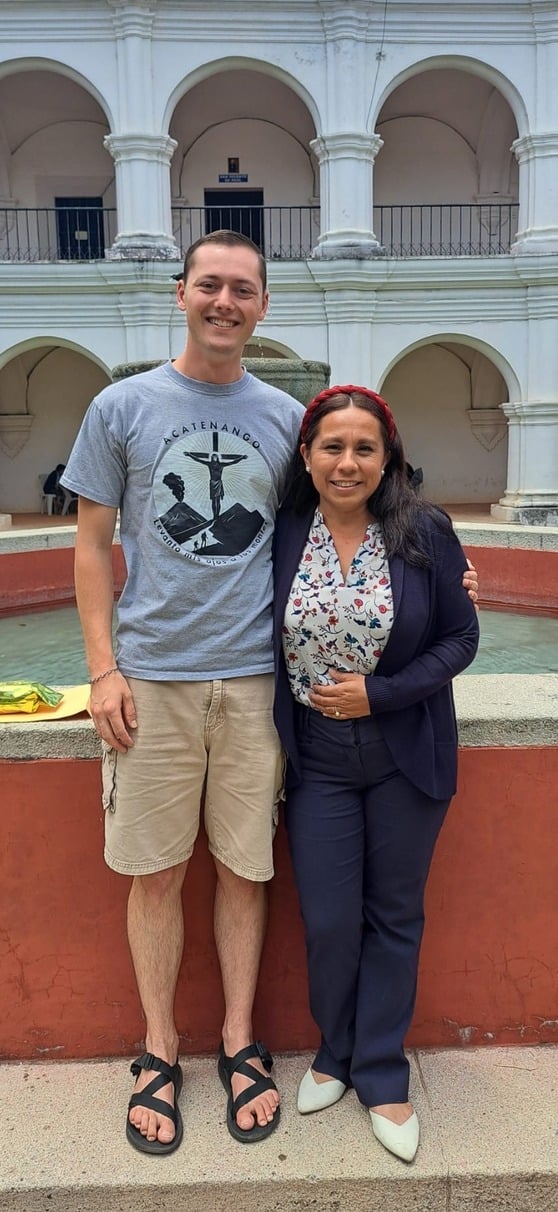 Hugeback with his maestra.“Day one was pretty rough,” the St. Joseph parishioner said. “When we showed up – nobody spoke any English. We got in a van with a guy who didn’t speak English and then we went and showed up to the house and our host parents didn’t speak English.”
“You are your own interpreter. It was really hard,” Fitzsimmons recalled. “I didn’t hardly know any Spanish.”
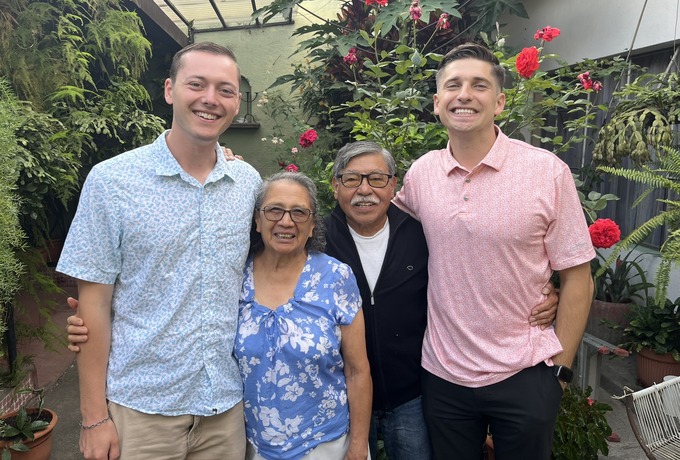
The two were guests of Carlos and Carmen – an older couple with grown children no longer living in the family home. The couple offered lodging and meals for the seminarians, who described their Guatemalan hosts as very holy and faith-filled Catholics.
“At first it was very formal – hi, nice to meet you,” Hugeback shared. “On the last day we were making fun of each other, joking around and lots of hugs. We very much became part of the family … We got more than a living situation. We got the family experience there and really built good relationships with them.”
“The mom, Carmen, was almost 80 years old and she just wanted to take care of us,” Fitzsimmons stressed. “She would cook our meals for us then stop in and ask us how it is. We’d say, ‘Oh, it’s so good.’ … That was lunch and breakfast. Then for dinners we would eat together all of us as a family.”
As part of the immersion experience, the two spent their weekdays learning Spanish at a former convent, working one-on-one with their assigned maestra, or teacher. Classes were held outside around the courtyard as the Guatemalan weather was always comfortable. Each student was paired with the same maestra for the entire six-week experience. All instruction was held in Spanish.
“The first day you walk in and they start speaking Spanish,” Fitzsimmons described his struggle. “I thought, oh my goodness, I am not ready for this. She goes and goes and I think, she thinks I understand what she’s saying. I get the meaning of every 10th word because they’re talking so fast.”
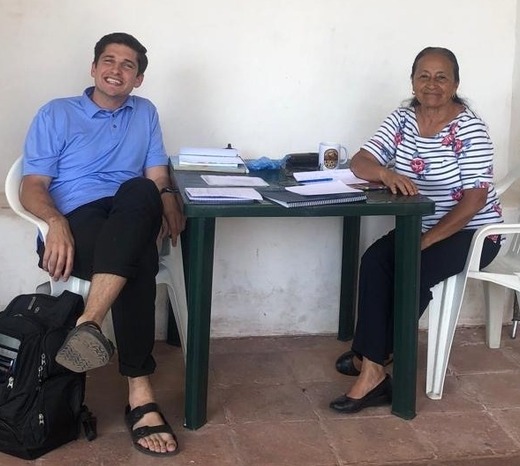 Fitzsimmons and his maestra in the school's courtyard.The students would spend six hours a day learning from their instructors. Hugeback explained that each maestra tailored the lessons for their students. His lessons were mainly conversational Spanish and priests taking lessons at the school focused more on liturgy and ministry language.
“The first week, my brain felt fried. Even listening to little conversations, I thought this is so hard,” Fitzsimmons said, explaining that he would constantly mentally reconstruct Spanish sentences he heard into English. “It was really tiring. Towards the end you could kind of listen and not reconstruct.”
As the days and weeks went by the seminarians were building their Spanish speaking skills including vocabulary, verb forms and conversational Spanish.
“You are learning super-fast but it’s very challenging,” Fitzsimmons said, adding that it was a struggle to express himself with a limited vocabulary and not be misunderstood. “I definitely needed to learn to be okay with making mistakes, being wrong.”
When not in class, the seminarians mingled with the locals and visited different areas of the region. They soon found the Guatemalans to be gracious and friendly towards the visitors.
“They were very interested. People everywhere you went wanted to know where everyone was from,” Hugeback said.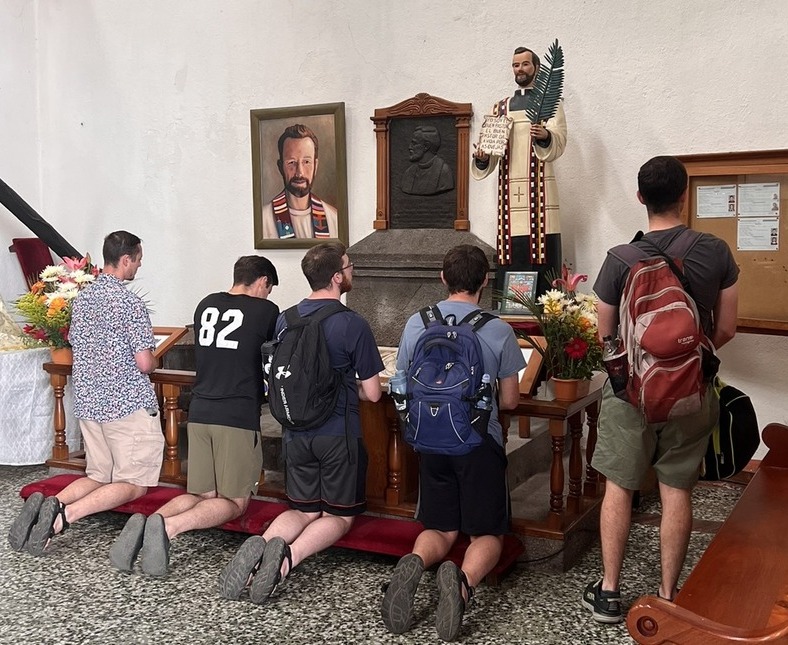 Praying at the church where Bl. Stanley Roethler was martyred.“The greatest thing is how joyful they were for us just trying to speak Spanish,” Fitzsimmons said. “You see a couple of six-foot white guys walking through Guatemala – yeah, you’re clearly not Guatemalan. Even when we were stumbling over our words, they were joyful that we’re trying, so happy that we made an effort to communicate with them.”
The Cathedral parishioner said the challenges he experienced and then the support he received from the Guatemalans during the immersion helped him to empathize with Spanish speakers in northwest Iowa.
“I think that’s something we can do better at in the U.S. when we have native Spanish speakers who are trying to speak English. We should say, ‘Thanks for trying. This is something very, very foreign to you. I’m so glad you want to try to communicate with me,’” he said. “We should be more appreciative for so many Hispanics in our diocese who try so hard to communicate in a second language.”
Hugeback said the two wanted to take advantage of the opportunity to explore Guatemala as it was “a once in a lifetime” opportunity. Most sites were within walking distance and easy to navigate. They explored area shrines and spent time outdoors including hiking on volcanoes.
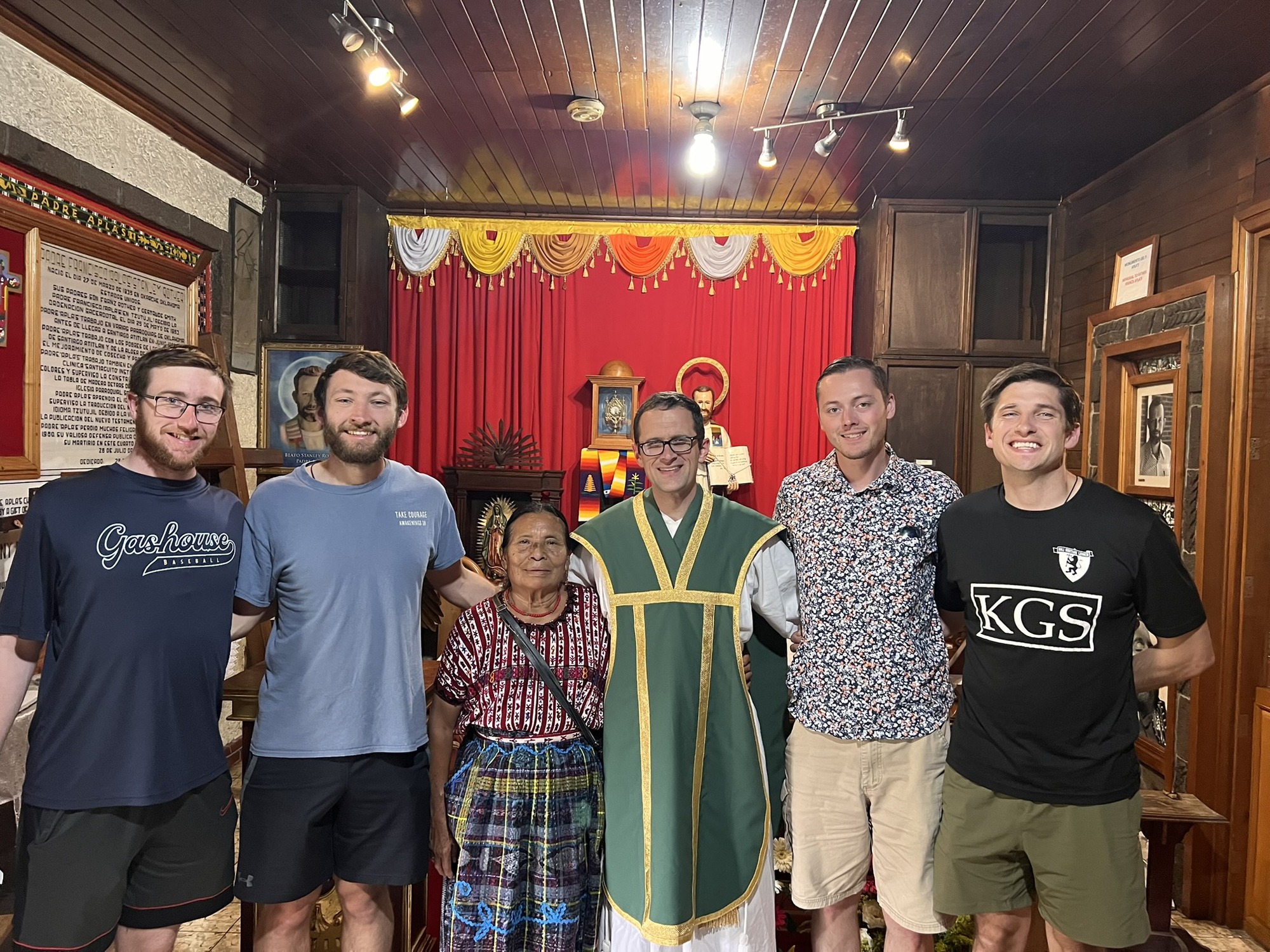
“One weekend we went to Lake Atitlan – the place where Bl. Stanley Roether was martyred. We got to see the church and meet the people who were involved with him over there,” he said.
Strong faith
The influence of the Catholic Church was strong in Antigua, the seminarians said. In the 10-block square area where they stayed and attended classes, there were numerous churches and ruins of churches.
 “There were four major church options and each of them had multiple daily Masses. It was not hard at all to find a place to go to Mass,” the St. Joseph parishioner said, noting they had Spanish missals to help them follow along. “I liked just being able to go, sit in the pew and try to learn the Mass parts.”
“Things that were the most surprising to me was the devotion, how devout the people were. In this little town there were probably 15 daily Masses and every one was fairly full,” Fitzsimmons said.
Often, it was in the every day conversations where the seminarians were challenged the most as they communicated in Spanish.
“It was like a second class being with the host family,” Fitzsimmons said, pointing out they often had long conversations after the evening meal. “They’re just a normal family who has experienced some hardships in their lives, too. So, we’re talking about real things now. This is real life and we’re encountering these people we’ve grown to love over the last six weeks. I want to give them the love of Christ but the only way to do so is in Spanish.”
He had a similar experience with his maestra – communicating conversationally with her and then developing a friendship with the 72-year-old Guatemalan teacher with 40 years of teaching experience.
“My teacher knew I need to talk and chat for a while at the start of every day and that’s what we did,” the seminarian said. “What I didn’t think about is the depth of the relationship you begin with someone you spend six hours a day with for six weeks … When you talk that long for six hours a day you get into some deep stuff. It’s a really cool way of doing ministry one on one in a foreign country.”
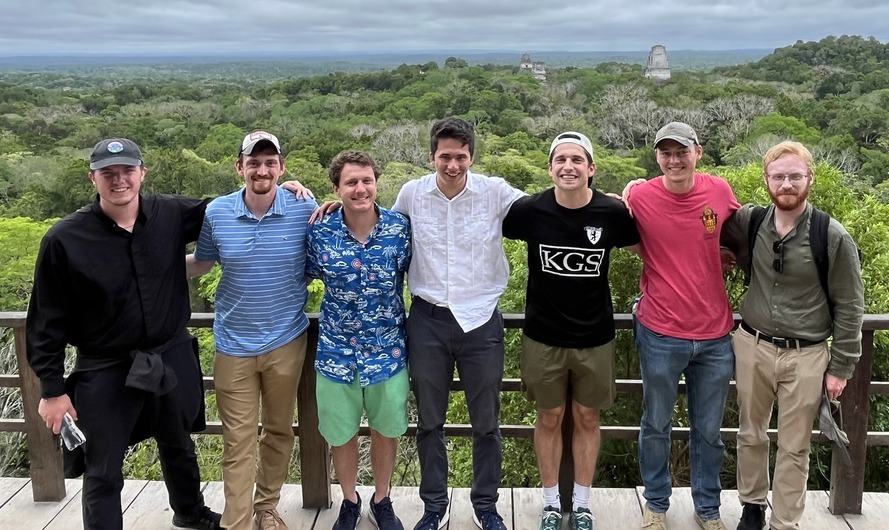 Neither claimed to be fluent following the immersion experience but said they are excited about what they learned about the language and culture. They also felt the time spent in Guatemala helped them in their vocation formation and their relationship with God.
“I never felt alone. It was such a grace to have prayer, to have the church. At the end of the day the Mass is the Mass,” Fitzsimmons said, noting that his daily Mass participation was a blessing to him.
“It’s a new way to go out and experience (God) and train my heart to long for the people of God even more and to want to bridge those barriers – go out to all people,” Hugeback said. “There were some really profound experiences there, forming my priestly heart.”