
Search
OCIA workshops train ministry teams, clergy and catechetical leaders on new translation
-
 October 3, 2025By RENEE WEBB
Content and Design Coordinator
A series of workshops on the Order of Christian Initiation of Adults (OCIA) were led by presenters from the Liturgy Training Publications (LTP) in the Diocese of Sioux City Sept. 25-27 at St. Mary Parish in Storm Lake.
According to Karmen Bower, director of the Office of Faith Formation for the diocese, her office co-sponsored the presentations with the Office of Worship in collaboration with Clergy Continuing Education.
“This was a great opportunity for collaboration between the offices so we had pastors, parish leaders and lay volunteers all hearing essentially the same message,” she said. “I hope this means that they can go back to the parish and have conversations all starting from the same place, the same point of information received.”
Change from RCIA to OCIA
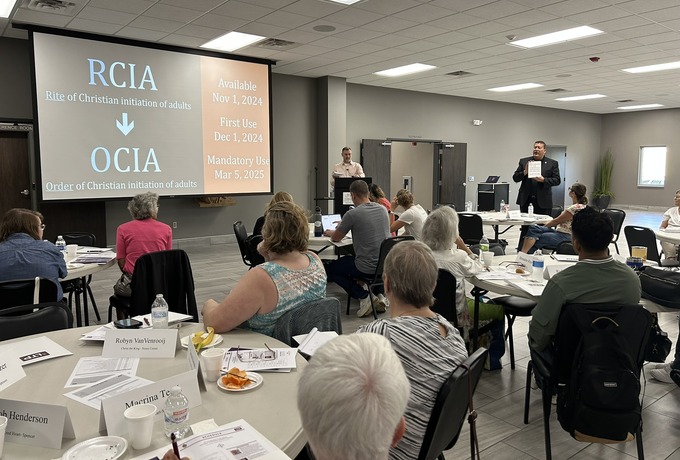
It was in 2021 when the U.S. bishops approved a new translation for the process of those seeking to join the Catholic Church, updating and renaming the Rite of Christian Initiation of Adults (RCIA) to OCIA. The new translation went into effect Dec. 1, 2024, with mandatory use by March of 2025.
The two presenters were Timothy A. Johnston and Father Stephen S. Wilbricht, CSC. Johnston, pastoral associate at a Chicago-area parish and editorial consultant for LTP, holds masters degrees from St. John’s University in Collegeville, Minnesota, and Marquette University in Milwaukee. Father Wilbricht, who earned a doctorate from the Catholic University of America, is a liturgy and Scripture teacher at Stonehill College near Boston as well as author.
While the revised text itself has had only limited updates, as Father Wilbricht noted, the speakers outlined some of the differences such as a change in vocabulary and the necessity of a paradigm shift in how parishes offer and structure OCIA.
Recognizing that the OCIA is a liturgical rite, Bower said they not only hope that the parishes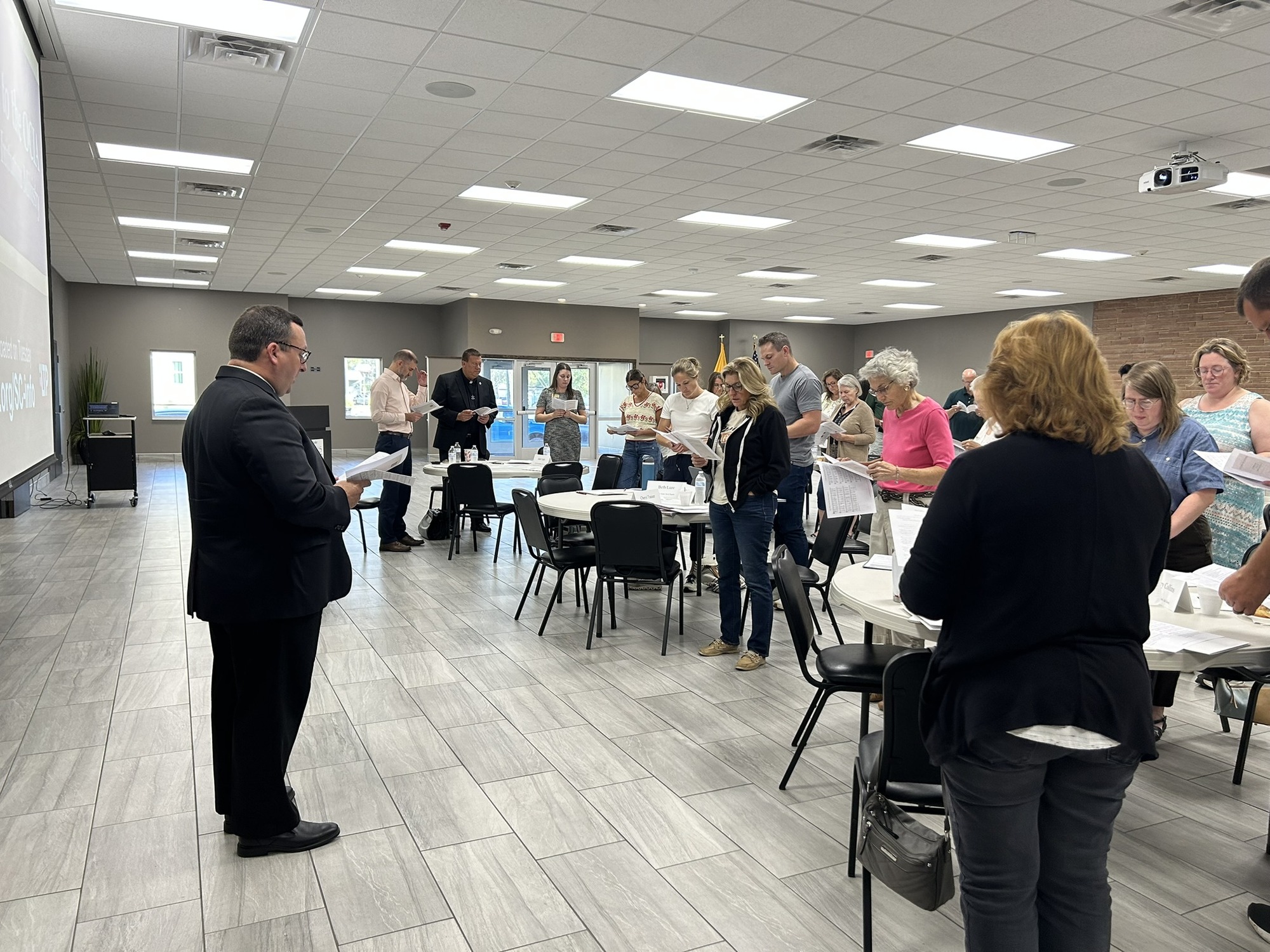 Father Andrew Galles leads morning prayer. will incorporate more of the rites along the way, but she found “the presenters offered a great vision that this process is not just a classroom experience for those entering the church. They are really invited into the parish community as a whole because at the end of the day the mission of a baptized Catholic is evangelization – spreading the Gospel, accompanying who are seeking the truth and inviting them into the Catholic faith.”
The first workshop was presented to priests and deacons Sept. 25 for their fall Clergy Day. It focused on the new translation of the OCIA ritual text and explored ways to implement the vision throughout all parish life.
The Sept. 26 workshop was a professional development day for DREs and catechetical leaders that was centered on adapting OCIA for children.
“This session was very much focused on children. Children who are above the age of reason, if they have not been baptized and are seeking baptism, they go through the same process as a standard adult,” said Bower. “Once they hit the age of reason, they are the ones making those decisions and considering what they are seeking from the church.”
Because these leaders work with children, the Office of Faith Formation wanted to equip them with a general understanding of the process, terminology and examples of how it could be integrated into their programming. Throughout the workshop, the catechetical leaders had the chance to learn about various models, share best practices and consider ways to collaboratively prepare for liturgical rites.
Vision of OCIA
OCIA leaders and ministry team members were encouraged to attend the Sept. 27 workshop titled, An Introduction to the OCIA: The Vision of Christian Initiation Ministry. The presenters gave an overview of the stages/periods of the initiation process along with correlating rites and offered pastoral principles associated with the ministry.
Father Wilbricht explained there needed to be a change in how OCIA was viewed so it wasn’t thought of as merely a program. Acknowledging that when he was working with RCIA years ago in Pheonix, he tried to make it the best “program” possible and wasn’t thinking about how it was part of the life of a parish.
“This is really about evangelizing people within a community, outside of a program,” said the priest. “This is really about the parish and what it means to be a praying community, an apostolic community that is always wanting to invite people into it for hospitality.”
Parish involvement, relationships
Relating to the importance of welcoming, Johnston said parishes should explore ways they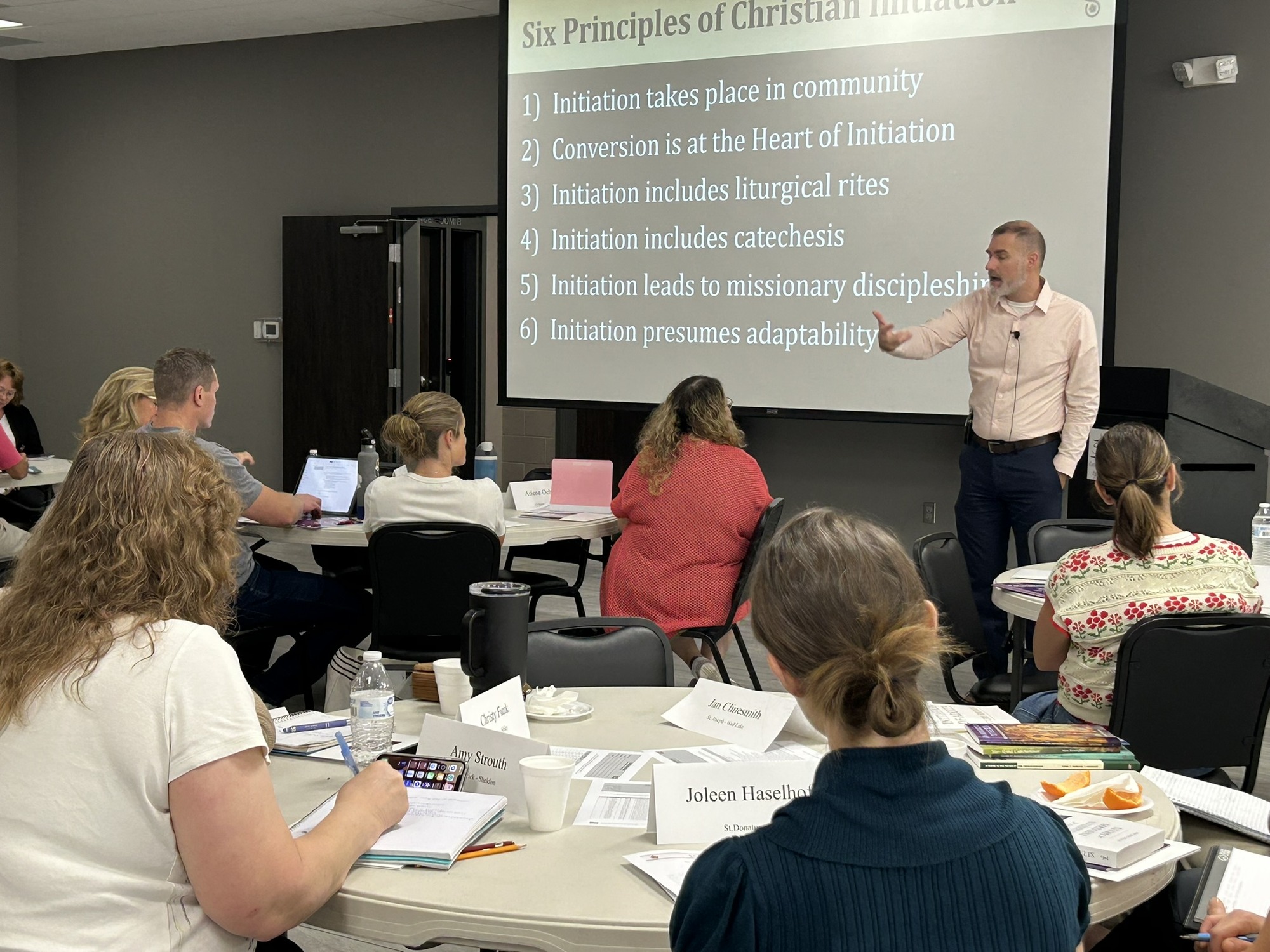 Timothy A. Johnston was a presenter with Father Stephen S. Wilbricht, CSC. Johnston, from LPT.can use the community as a primary source of formation not just for the unbaptized, but for candidates/inquirers and all members.
With that in mind, he said the parish community has the primary role in forming those who want to become Catholic. OCIA ministers are the facilitators of the process.
“We are really good at sacramentalizing people, but not very good at evangelizing,” said Johnston. “We are very good at giving the sacraments without discerning readiness.”
Most people learn by doing, he said, adding the same is true for learning how to be Catholic by participating in the life of the church. That can be done in part by tapping into all of the offerings by groups of the parish and even through social activities and friendships.
“So many of my students talk about struggling to belong. They don’t feel like they belong to the church,” said Father Wilbricht. “When we talk about the period of evangelization, I think it’s all about relationships.”
More fluidity in structure, timeline
The speakers said rather than having a process that is set on a time-line similar to a school-year – starting in early fall and concluding at the Easter vigil – a year-round process is recommended with people brought into the precatechumenate right away rather than having to wait several months for next set of classes to start in fall.
“We are welcoming people as they come, we are receiving them into the catechumenate as they come,” said Johnson, who added that the church wants parishes to celebrate the Rite of Entrance two to three times in the course of the year if they have people who want become part of the church.
The length of time needed to join the church is variable based on the individual and several factors such as their knowledge coming into the process, Catholic role models they have in their lives, their participation in the life of the church and so on as listed in OCIA #75.
Because of the varying factors, they noted it is hard to be an actual timeline on the process for catechumens.
“There is more fluidity to the process, it is not a hard and fast time structure,” said Johnston, who noted that topics covered in classes could be covered in relation to what is happening during the liturgical year. For instance, catechesis about the Eucharist could happen near the feast of the Body and Blood of Christ.
Bower pointed out that on Clergy Day, the presenters went through quite a bit of depth the changes, so as pastors they would know the expectations for them and they gave many examples of how it was implemented in their own parishes.
“The examples were good at expressing how we look at each individual person – don’t just plug them into a calendar that pushes them through,” she said. “There might be two people seeking baptism but their paths forward might look differently.”
The speakers said the path and formation needed for those who are already baptized might – and most likely will – also look different from each other based on their backgrounds and knowledge of the faith.
Regular meetings for non-baptized
Another shift in thinking, noted the speakers, relates to who attends the regularly scheduled OCIA classes.
The classes should be intended for the catechumenate, they said, not for baptized coming into the process.
“The church says in the ritual that no unnecessary burden should be placed upon them (candidates), so the goal is communion with the body of Christ,” said Johnston. “So, the easiest path forward is what we are going to do – not because we don’t want them to learn anything but unity is the goal.”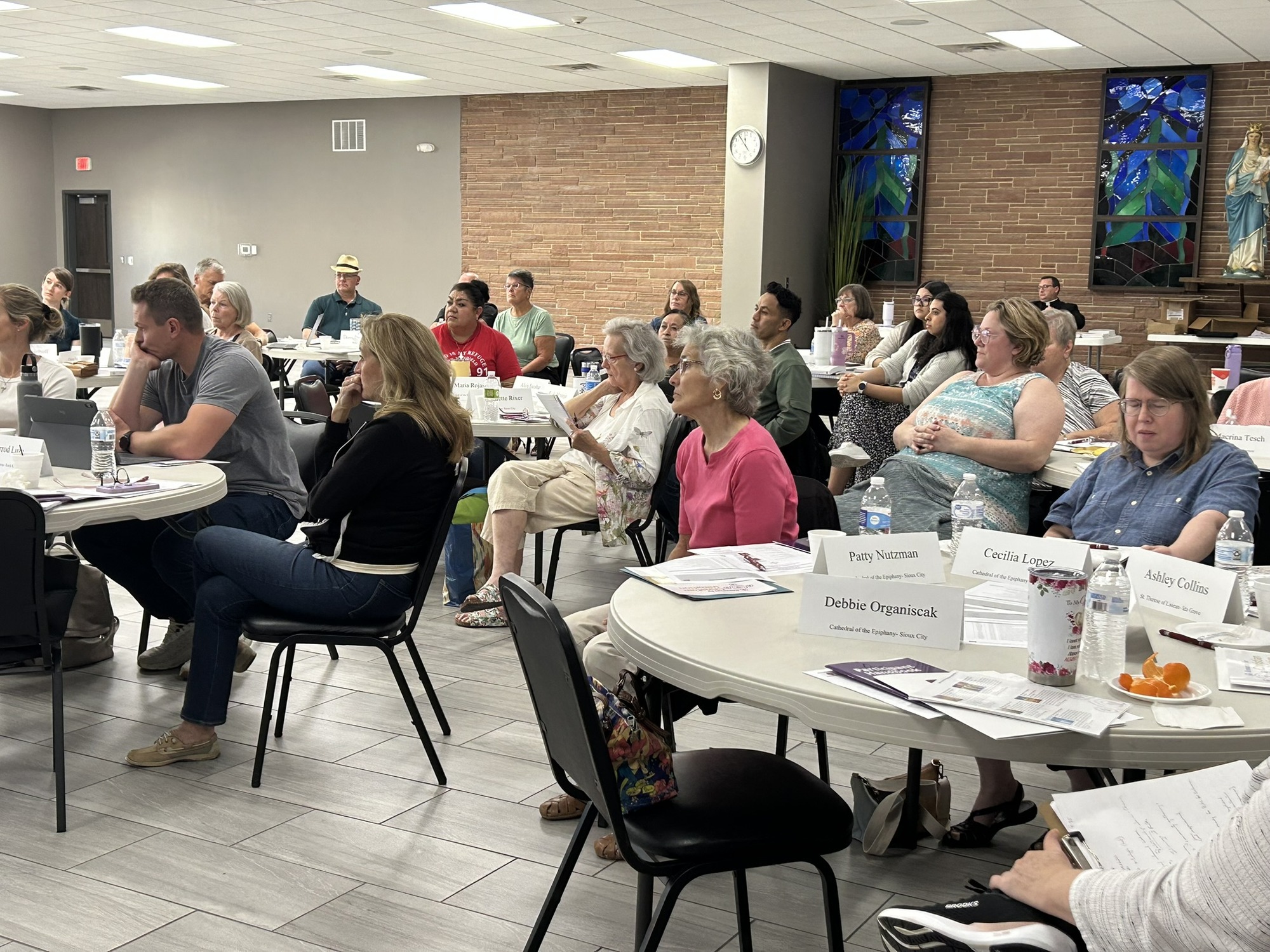 Since they are already baptized – be it a Catholic or Protestant baptism – traditional OCIA classes are not really intended for them. However, some of the classes such as something on the true presence in the Eucharist could be very beneficial.
Johnston said these individuals will still need proper instruction, mainly sacramental preparation and just as the timeline is fluid for the unbaptized, the amount of time it will take to be fully received into the church will vary. For most who are already baptized, it will be four to six months to enter the church but if they are already highly catechized it could be less.
And while many parishes receive both the baptized and unbaptized into the church at the Easter vigil, because that liturgy is focused on baptism the speakers said the vigil is best suited and is the norm for the unbaptized to enter the church.
The candidates would enter into full communion with the church in a separate service which could be offered a few times a year.
The speakers also suggested another change in terminology, noting that the term converts should be used for unbaptized solely and not for previously baptized individuals who are joining or have joined the church.
Parishes to discern implementation
In the end, Bower noted, parishes will have to discern how this might look in their own parishes. The presenters encouraged them to start small – possibly selecting a few changes to make and building from there.
“It will be very exciting to see what fruit comes from discussions at the local level,” she said. “From the feedback we received, people left with a lot of enthusiasm. All of the groups were very inquisitive in a good way, asking the hard questions. The presenters did a good job of answering questions but also asking them to ponder and think it over. Not everything has a black and white answer.”
Bower said she was hopeful the training sessions were not the end but something that will start conversations in parishes.
“Once people are equipped with the knowledge, it is amazing what they can do,” she said.
In a related story, Father Galles and Bower have created an OCIA Deep Dive podcast series to assist OCIA teams.