
Search
Catholic hospitals serve area for 135 years
-
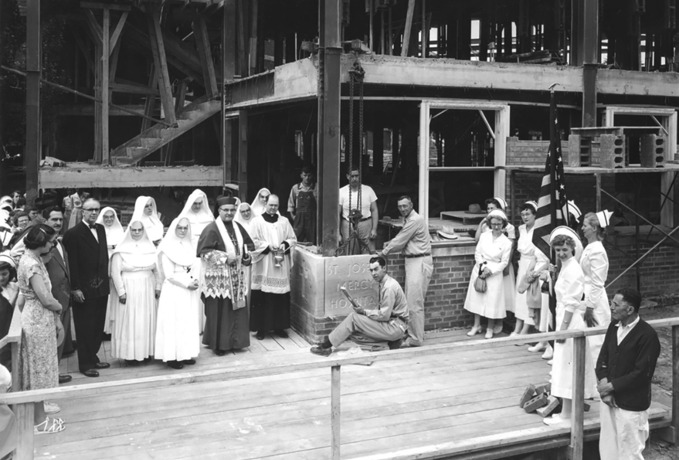 July 3, 2025Catholic hospitals have had a long-standing presence in Sioux City.
Although Sioux City was being served by Samaritan Hospital that opened in 1884, by the end of that decade the Sisters of Mercy were asked to establish a Catholic hospital in the community.
The first Catholic hospital opened in Sioux City in 1890 led by the efforts of the Sisters of Mercy. Mother Mary Agatha Murphy purchased a home from John Peirce on the corner of 28th and Jennings Streets in 1890 and by May of that year St. Joseph’s Mercy Hospital treated its first patient, who had a diagnosis of typhoid fever.
Just a few months later, the sisters moved 20 patients into a different building.
Later that year the sisters were able to build three-story brick hospital at 21st and Court Streets which cost $20,000. That building was Sioux City’s first building to be constructed as a hospital.
To train women, St. Joseph’s School of Nursing opened in 1902. By 1910, a new addition was added that allowed the hospital to serve up to 200 patients and another addition – which housed a 150-seat chapel - was completed in 1925. A five-story addition was added in 1943 and a six-story wing was underway in 1952.
While the Sisters of Mercy played a major role in Sioux City’s early Catholic healthcare ministry, another religious community was also significant.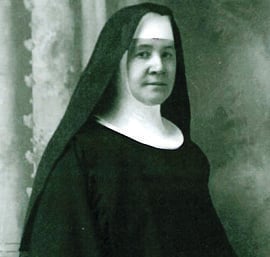 Mother GertrudeIn 1897, Sister Gertrude – a member of a Benedictine community from Conception, Missouri, received permission from Pope Leo XIII to establish a separate community known as the Sisters of St. Benedict of Sioux City.
Initially the new community of sisters established a home for working girls in 1901 and that was remodeled into St. Vincent Hospital in 1907. By 1910, the Benedictines opened St. Vincent School of Nursing. Mother Gertrude then established St. Monica’s Home for orphans and unwed mothers in 1914. A new St. Vincent Hospital was dedicated in 1918.
Mother Gertrude’s order remained in Sioux City until 1953 when the community moved to Wisconsin.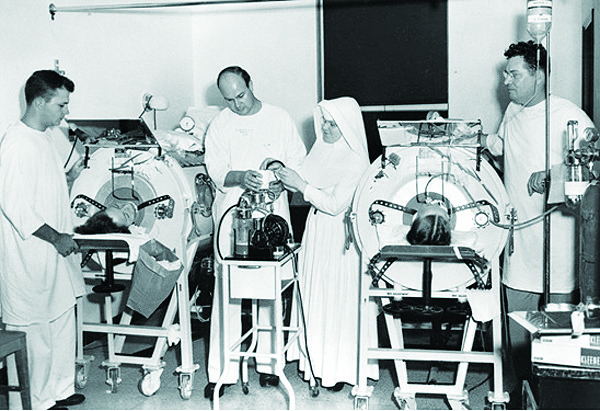 St. Joseph's had nine iron lungs during the polio epidemic.
St. Joseph’s opened Sioux City’s first outpatient and emergency department in 1940 and established Iowa’s first cancer center and a psychiatric unit in 1948. During the polio epidemic nine out of 11 iron lungs in the city were at St. Joseph’s.
Sioux City’s two Catholic hospitals announced a merger in 1977 and a groundbreaking ceremony for the new $28 million hospital was held in 1979. The new unified Marian Health Center opened in 1982 and about at that time, the facility was certified as a state-designated trauma center – one of just three in the state.
In 1993, Marian Health Center partnered with St. Luke’s Regional Medical Center and Sioux City’s Medical and Radiation Oncologists for the Siouxland Cancer Center and joined a partnership with surgeons in the development of Siouxland Surgery Center in 1994.
The trauma center saw the nation’s first with the dedication of a hospital-based decontamination unit made possibly through a 1996 gift by Terra Industries.
Marian Health Center changed its name to Mercy Medical Center in 1999 in honor of the Sisters of Mercy. The next year the hospital became part of Trinity Health. In 2013, two of the country’s largest Catholic hospital systems - Trinity Health merged with Catholic Health East - merged.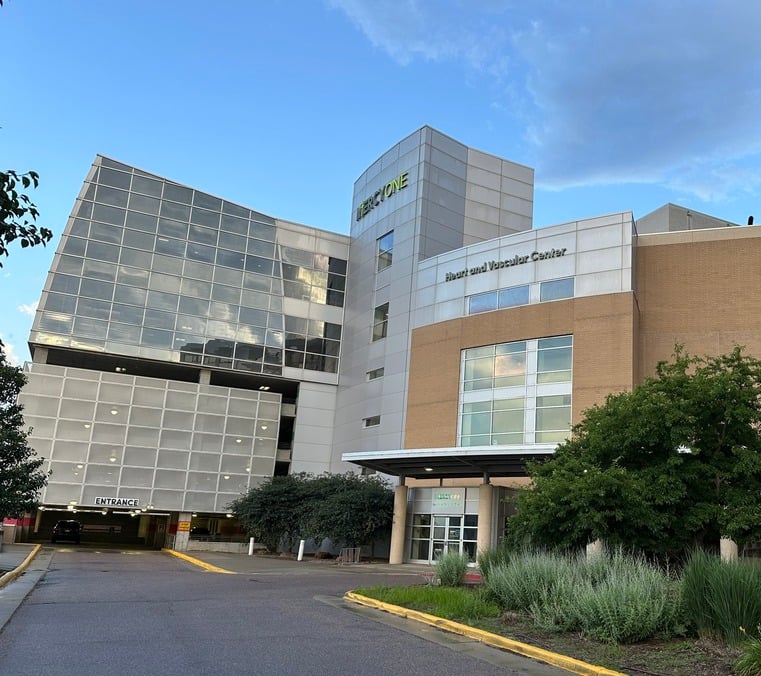 The addition of a heart center in 2003 was one of the latest large-scale projects at Mercy.One of the latest large-scale projects for Mercy was the $20 million construction of the Mercy Heart Center that was dedicated in 2003.
Mercy’s name changed to MercyOne Siouxland in 2019.
In late May, 2025, UnityPoint Health and MercyOne Siouxland Medical Center signed a letter of intent (LOI) for UnityPoint Health to acquire MercyOne Siouxland Medical Center and its facilities, including the hospital, physician practices and home care services.