
Search
-
 December 11, 2025(Bilingual - Spanish below)
By FATHER DAVID ESQUILIANO
Judicial Vicar
On Monday, we celebrated the solemnity of the Immaculate Conception, patroness of our nation. While I’ve used that expression—our nation—before, as of last Friday it has taken on another meaning, because I became a U.S. citizen. Some of you already knew this because I shared it on my Facebook page, but not everyone is on social media, and if you will indulge me, I’ll expand a bit on how I got here.
I’ve shared before that, growing up, my pastors were Irish missionaries. When I started feeling the call to the priesthood, I always equated priesthood with going to a far-off land, learning a new language, and embracing a new culture. I tried religious life briefly, but I discerned out. I worked for a while, became a computer engineer, and gave up on the idea of priesthood; but God obviously hadn’t given up on me.
Sometime between the end of 2005 and early 2006, a friend whom I had met while trying religious life asked me if I still felt that God wanted me to be a missionary priest. He was studying for a U.S. diocese, and in fact now he’s a priest in San Antonio, Texas. Even though my first response was “no,” as I was enjoying being a computer programmer, I decided to explore the idea. With his help I contacted some dioceses that, he said, would be willing to receive seminarians from Mexico.
Months later, in the spring of 2006, Father Brian Hughes, then vocations director for the Diocese of Sioux City, came to Mexico and we met. He invited me to come visit that summer or fall and decide whether I wanted to apply to become a seminarian for Sioux City. I applied for a visa, which unfortunately was denied. I tried again months later, and this time it was granted, so on Feb. 21, 2007, I arrived in Sioux City for the first time.
I stayed at the Cathedral, thanks to the hospitality of Father Paul Arts, then rector. Within days I had met many parishioners here, including Deacon Jorge and Santa Fernandez. I felt welcome here, so I decided to apply to seminary for this diocese. Bishop (Emeritus Walker) Nickless sent me to study in Missouri for a couple of years, and then to Rome for four years. I was ordained here at the Cathedral of the Epiphany on June 29, 2013.
My first assignment was as parochial vicar at St. Mary’s in Storm Lake and St. Joseph in Schaller. Because I needed to get a worker’s visa, I could not begin my assignment immediately, which allowed me to spend time with my family—especially needed after my mom’s passing just a couple of days after my ordination.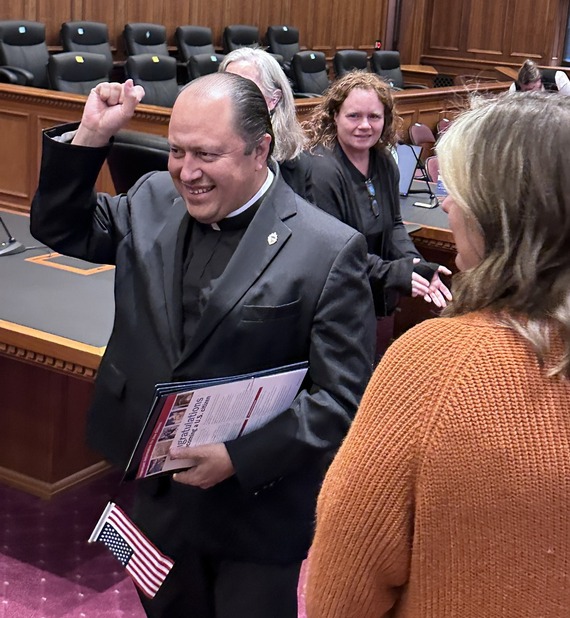 Three years later, Bishop Nickless assigned me as parochial administrator of the parishes of St. Thomas in Manson, St. Mary in Pomeroy and St. Francis in Rockwell City. After a year there, Bishop Nickless sent me back to Rome to finish my studies in canon law, which I had begun the year prior to my ordination.
What many people don’t know is that this was also a calculated risk, as I began the process to become a permanent resident, which required me to spend some time out of the country. We didn’t know how long it would take, but we were hopeful it wouldn’t be much longer than two years—and we were spot on, because as I was getting ready to conclude my studies, my immigrant visa was granted.
On June 21, 2019, I came back to the U.S. and became a permanent resident. This was also when I began my assignment here at the Cathedral.
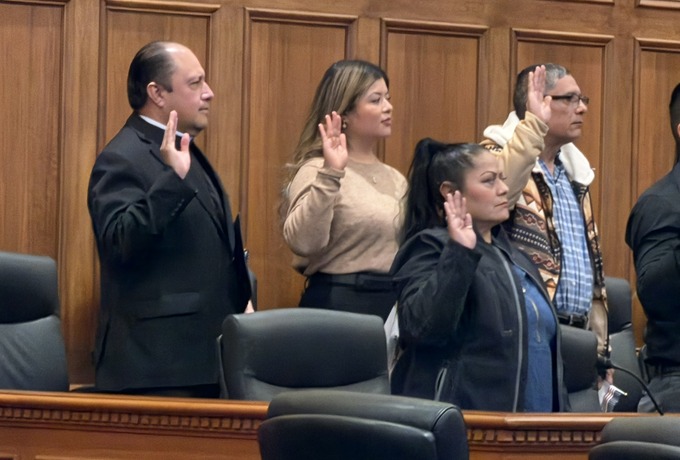
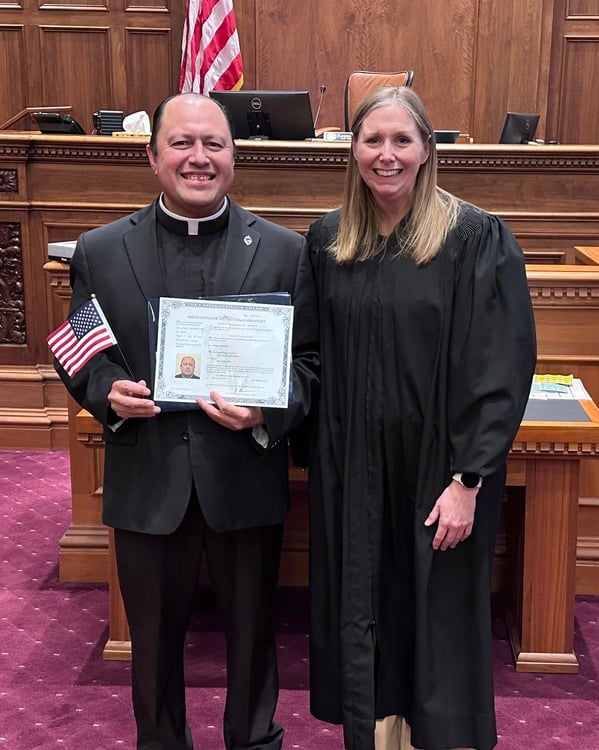
A couple of years later I became the judicial vicar for the diocese. In December of 2024, having completed the required five-year residence, I contacted the Welcome Program at Catholic Charities of the Diocese of Sioux City and asked for their assistance in requesting naturalization. With their help I submitted the paperwork, and on Oct. 10 I passed the required civics and English test. Then, last Friday, I took my oath as a citizen of this great country.
There have been difficult times on this journey: times when I even asked God if he really wanted me here in northwest Iowa; difficult relationships with some people; not being able to be with my family in hard moments, like the passing of my dad or my cousin Jazmin; times I have felt rejected because of my place of origin. But God has always found ways to assure me that he called me here and that this is where he wants me. Becoming a citizen is both a sign of that call and a fruit of those many signs along the way.
I have said before that I feel blessed to be an immigrant pastor of our still primarily blue-collar immigrant parish in the diocese. Being an immigrant helps me appreciate the struggles that many of our parishioners go through, although unlike many of them I have been blessed to have the support of the diocese behind me. And for those who have no idea, that also means the diocese has spent thousands of dollars to support me with immigration legal expenses.
If you have indulged me by reading all of this, thank you. I hope it helps you not only to know a little bit more about me, but also to understand how expensive, difficult and lengthy this kind of process is. Below you will find some pictures of the ceremony. I was joined by brother priests and parishioners, and while I wish I could have invited you all—and I am sure many of you would have come—I couldn’t. But please, join me in thanking Our Blessed Mother for her intercession and accompaniment on this journey.
Un camino a la ciudadanía
Por PADRE DAVID ESQUILIANO
Vicario Judicial
El lunes celebramos la Solemnidad de la Inmaculada Concepción, patrona de nuestra nación. Aunque ya antes había usado esa expresión —nuestra nación—, desde el viernes pasado tiene para mí un significado nuevo, porque me convertí en ciudadano de los Estados Unidos. Algunos de ustedes ya lo sabían porque lo compartí en mi página de Facebook, pero no todos están en redes sociales y, si me lo permiten, quiero compartir un poco más sobre cómo llegué hasta aquí.
He contado antes que, cuando yo crecía, mis párrocos eran misioneros irlandeses. Cuando empecé a sentir el llamado al sacerdocio, siempre lo asocié con ir a una tierra lejana, aprender un nuevo idioma y abrazar una nueva cultura. Probé la vida religiosa por un tiempo, pero discerní que no era mi camino. Trabajé un tiempo, me hice ingeniero en computación y renuncié a la idea del sacerdocio; pero Dios, evidentemente, no había renunciado a mí.
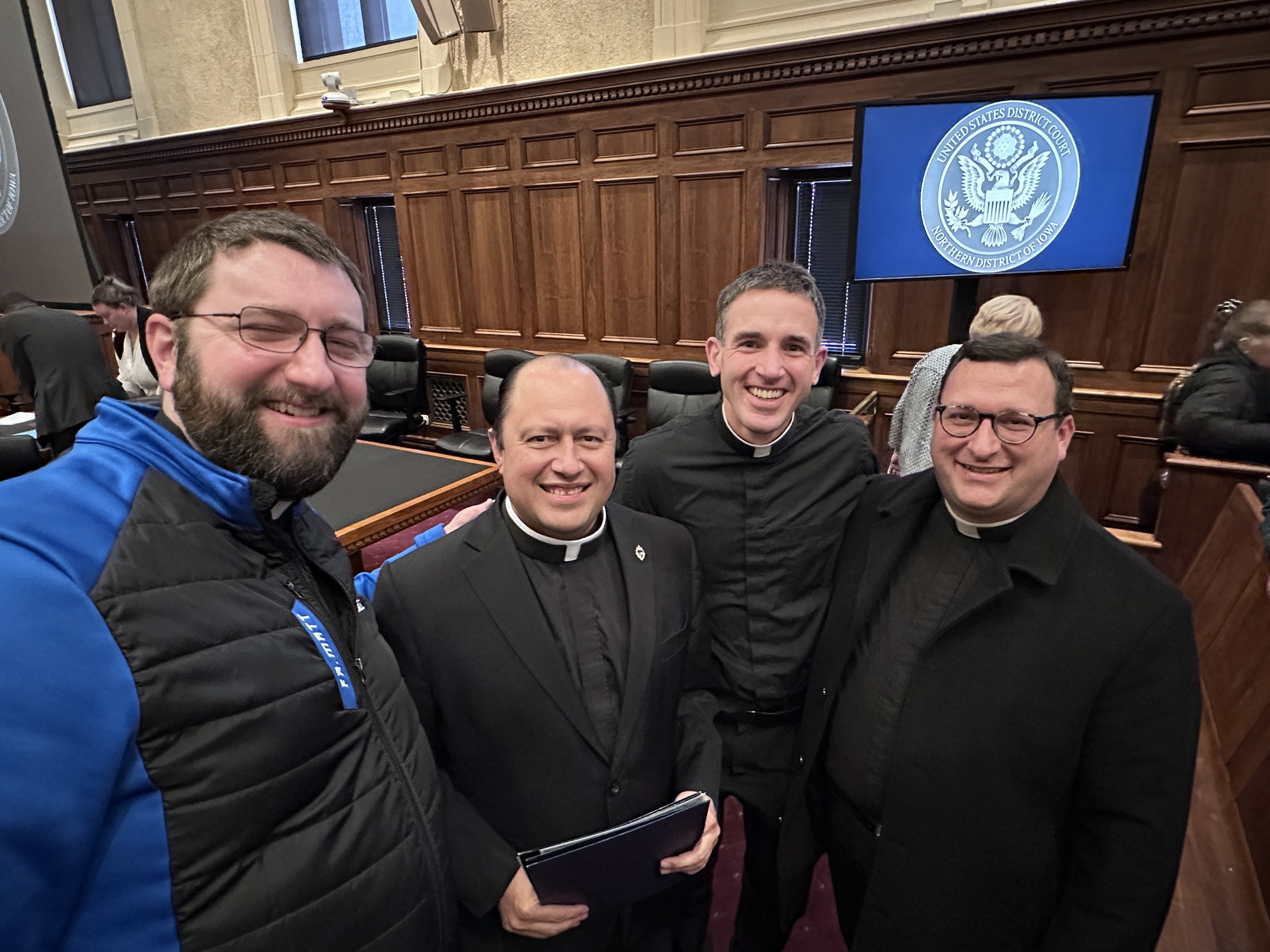 P. Matthew Niggemeyer, P. Esquiliano, P. Michael Cronin y P. Andrew GallesEntre finales de 2005 y principios de 2006, un amigo a quien conocí mientras probaba la vida religiosa me preguntó si todavía sentía que Dios quería que yo fuera sacerdote misionero. Él estaba estudiando para una diócesis de Estados Unidos y, de hecho, ahora es sacerdote en San Antonio, TX. Aunque mi primera respuesta fue “no”, porque estaba disfrutando ser programador, decidí explorar la idea. Con su ayuda contacté algunas diócesis que, según me dijo, estarían dispuestas a recibir seminaristas de México.
Meses después, en la primavera de 2006, el P. Brian Hughes, entonces director de vocaciones de la Diócesis de Sioux City, vino a México y nos conocimos. Me invitó a venir de visita ese verano u otoño y decidir si quería solicitar ser seminarista para Sioux City. Solicité una visa, que lamentablemente fue negada. Lo intenté de nuevo meses después y esta vez fue aprobada, así que el 21 de febrero de 2007 llegué por primera vez a Sioux City.
Me quedé en la Catedral, gracias a la hospitalidad del P. Paul Arts, entonces rector. A los pocos días ya había conocido a muchos feligreses aquí, entre ellos al Diác. Jorge y a Santa Fernández. Me sentí bien recibido, así que decidí solicitar el ingreso al seminario para esta diócesis. Mons. Nickless me envió a estudiar a Missouri por un par de años y luego a Roma por cuatro años. Fui ordenado aquí, en la Catedral de la Epifanía, el 29 de junio de 2013.
Mi primera encomienda fue como vicario parroquial en Santa María en Storm Lake y San José en Schaller. Como necesitaba obtener una visa de trabajo, no pude empezar de inmediato, lo cual me permitió pasar tiempo con mi familia, algo especialmente necesario después del fallecimiento de mi mamá, apenas un par de días después de mi ordenación.
Tres años más tarde, Mons. Nickless me nombró administrador parroquial de las parroquias de Sto. Tomás en Manson, Sta. María en Pomeroy y S. Francisco en Rockwell City. Después de un año allí, Mons. Nickless me envió de nuevo a Roma para terminar mis estudios de derecho canónico, que había comenzado el año previo a mi ordenación. Lo que muchos no saben es que esto también fue un riesgo calculado, porque inicié el proceso para hacerme residente permanente, lo cual requería pasar un tiempo fuera del país. No sabíamos cuánto iba a tardar, pero teníamos la esperanza de que no fuera mucho más de dos años, y acertamos, porque cuando me estaba preparando para concluir mis estudios, me fue concedida la visa de inmigrante.
El 21 de junio de 2019 regresé a Estados Unidos y me convertí en residente permanente. Fue también cuando comencé mi asignación aquí en la Catedral. Un par de años después me nombraron Vicario Judicial de la diócesis. En diciembre de 2024, habiendo cumplido los cinco años de residencia requeridos, me puse en contacto con el programa Welcome de Catholic Charities de la Diócesis de Sioux City y pedí su ayuda para solicitar la naturalización. Con su apoyo presenté la documentación, y el 10 de octubre aprobé el examen requerido de educación cívica e inglés. Luego, el viernes pasado, hice mi juramento como ciudadano de este gran país.
 Ha habido momentos difíciles en este camino: momentos en los que incluso le pregunté a Dios si realmente me quería aquí, en el noroeste de Iowa; relaciones difíciles con algunas personas; no poder estar con mi familia en momentos duros, como la muerte de mi papá o de mi prima Jazmín; momentos en los que me he sentido rechazado por mi lugar de origen. Pero Dios siempre ha encontrado maneras de asegurarme que Él me llamó aquí y que aquí es donde me quiere. Hacerme ciudadano es a la vez un signo de ese llamado y un fruto de los muchos signos que he recibido a lo largo del camino.
He dicho antes que me siento bendecido de ser un párroco inmigrante de nuestra parroquia, que sigue siendo en gran medida una comunidad inmigrante de clase trabajadora en la diócesis. Ser inmigrante me ayuda a apreciar las dificultades que muchos de nuestros feligreses viven, aunque, a diferencia de muchos de ellos, yo he tenido la bendición de contar con el apoyo de la diócesis. Y, para quienes no lo saben, eso también significa que la diócesis ha gastado miles de dólares para apoyarme con los gastos legales de inmigración.
Si me ha concedido el favor de leer todo esto, muchas gracias. Espero que no solo le ayude a conocerme un poco mejor, sino también a entender lo costoso, difícil y largo que es este tipo de proceso. A continuación encontrará algunas fotos de la ceremonia. Me acompañaron hermanos sacerdotes y feligreses y, aunque me hubiera gustado poder invitarlos a todos —y estoy seguro de que muchos habrían venido—, no me fue posible. Pero, por favor, únase conmigo para dar gracias a Nuestra Santísima Madre por su intercesión y su compañía en este camino.
HOME