
Search
Father Kelly reflects upon priestly ministry as retirement nears
-
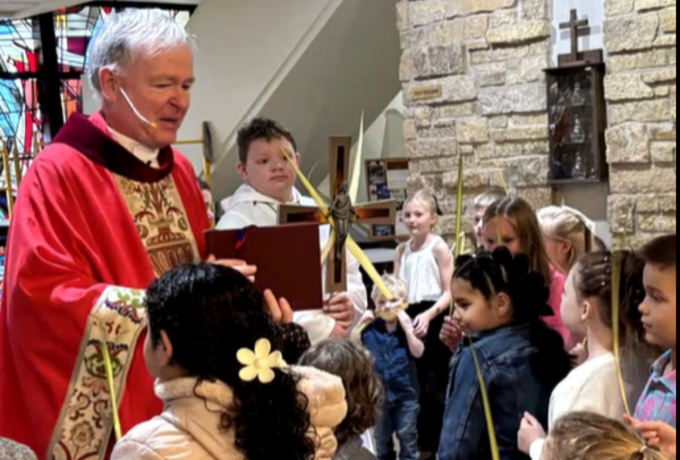 June 20, 2025(bilingual - Spanish below)
By RENEE WEBB
Content and Design Coordinator
When Father Paul Kelly was ordained to the priesthood in the early 1980s, he said he never would have dreamed that a large portion of his ministry would focus on ministering to Spanish speakers.
Of his 42 years in the priesthood, 25 have included Hispanic ministry. He said that aspect of his priestly service has not only been a nice challenge but also a joy through which he has made many friends.
“It also opened my world view to the universal church,” said Father Kelly, who will retire in July. “I understand a great deal about the Hispanic mindset, the culture and the richness of the faith that the culture brings, especially the devotion to Our Lady of Guadalupe.”
His initial thoughts of priesthood were during college years at Iowa State University in Ames when he started going to daily Mass at the Newman Center. That practice he noted lit a spark for him and initial thoughts of the priesthood arose.
A business administration major with an emphasis in accounting, he took a job with Deere & Company in February of 1977 after graduating a semester early. Eighteen months later, he headed to seminary.
“I made the decision in August of ’78 to leave my accounting career and go to the seminary. I was going to try it out for a year and see if I liked it,” said Father Kelly. “I made that decision 47 years ago and I’ve stayed with it so clearly it was the right decision.”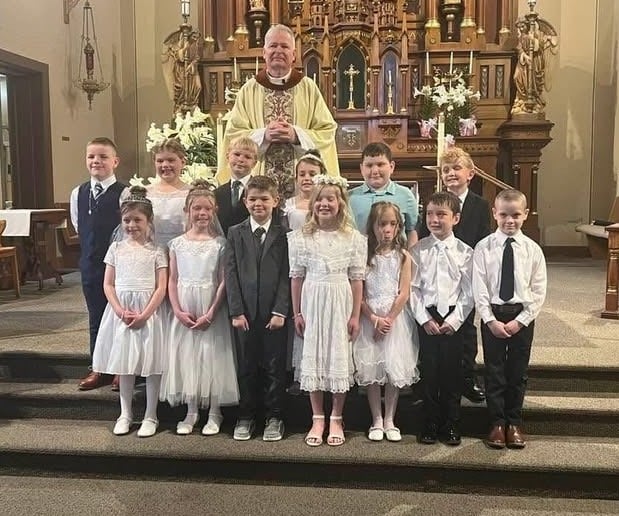 Father Kelly with first Communion class.He was ordained to the priesthood on May 28, 1983, at St. Joseph Church, Sioux Rapids, which was his home parish.
Father Kelly is currently the pastor of Emmetsburg Holy Family, Estherville St. Patrick and Graettinger Immaculate Conception. Through the years he has also served at Sioux City Immaculate Conception Parish, Fort Dodge Corpus Christi Parish, Halbur St. Augustine Parish, Roselle Holy Angels, Coon Rapids Assumption Parish, Glidden St. Elizabeth Seton, Sioux City Cathedral of the Epiphany, Denison St. Rose of Lima, Vail St. Ann, Dow City St. Mary, Charter Oak St. Boniface, Ute St. Mary, Manning Sacred Heart and Manilla Sacred Heart.“What drew me to the priesthood wasn’t schoolwork or preaching, it was the Mass. Without priests, you couldn’t have Mass,” said the priest, who noted that even back in the mid-1970s there was talk about a priest shortage. “I thought there has to be someone to lead the people in prayer. The sacramental aspect of the priesthood – the availability to offer Mass, bury the dead, to baptize and officiate weddings – was the big draw for me.”
While Father Kelly has spent his priestly ministry serving as a parish priest, he mentioned as was customary at the time he was ordained teaching in Catholic schools were part of his assignments early on. Through the years his pastoral work included helping with religious education and music ministry. In time, most parish assignments were in locations with Hispanic populations.
Taking up new call
“In 1997 Bishop (Lawrence D.) Soens sent out a letter to all of the priests outlining the need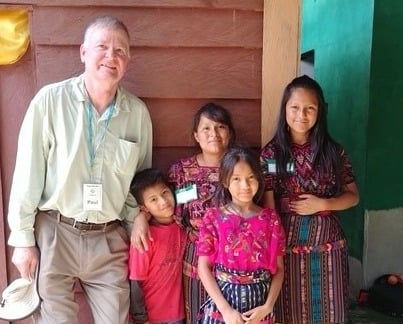 Father Kelly with Guatemalan family on one of his trips.for priests to serve in Hispanic ministries,” explained Father Kelly, who noted he has always been interested in the missions and even thought about becoming a missionary priest. “When this letter came out, I thought maybe this is the challenge I need. Instead of me going away to the missions, the missions will come to me.”
He was one of 10 to 12 priests who agreed to take a three-week Spanish course in San Antonio, Texas. Upon his return, he kept practicing and would even do a few of the readings at Spanish Mass.
“It grew from there,” said Father Kelly, who noted that prior to his first class he only knew about 10 Spanish words. “Every year I would go back for another advanced course.”
It was in 2005 that he went to Mexico for four months of intense study and immersion into the culture, parish ministry and language. That was the turning point when he was able to have full on conversations in Spanish and give homilies in Spanish without reading it from a piece of paper.
“When I was ordained in the 1980s, I would have never dreamed I would be saying Masses and doing ministry in Spanish. It just wasn’t even a part of my thinking,” said Father Kelly.
He commended the late Bishop Soens for having the foresight and being proactive in encouraging priests to learn Spanish in order to function at the basic level and provide the sacraments in the new parishioners’ native language. At the time, the priest recalled the diocese only had one native Spanish speaker in service.
“The northwest Iowa demographics have changed significantly so part of the adjustment to that was learning the language. I found that to be one of the greatest blessings of priesthood,” said Father Kelly. “It brought a richness to the priesthood that I otherwise would have missed.”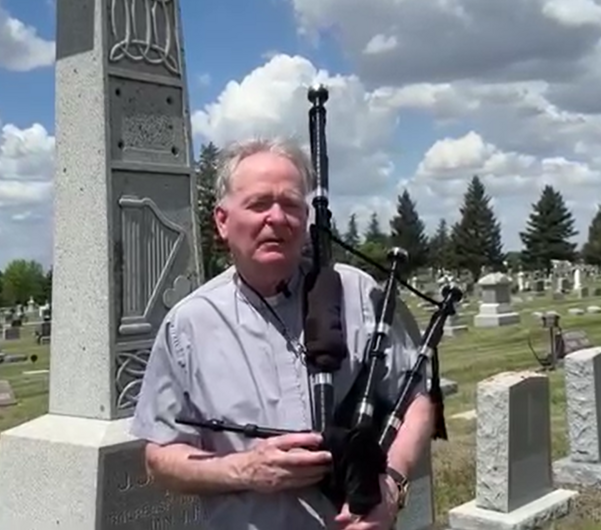 Father Kelly plays bagpipes.The priest mentioned that his desire to serve the faithful was one of the big draws to priesthood. Another area that has given him joy is in the music ministry, offering his musical gifts on the trumpet and bagpipes. He has even teamed up with a pianist friend to offer a few concerts.
Challenges
While the priesthood has offered numerous blessings for him, he acknowledged it isn’t without challenges.
“In some ways clergy have one of the hardest jobs in the world – to change hearts and minds,” said Father Kelly. “Christianity is about conversion – conversion of our being, moral makeup, the way we think and philosophical underpinnings of the way we act as human beings.”
One of the greatest challenges, he noted, is presenting the Gospel message in such a way that resonates with people so they can be drawn to the church.
“In northwest Iowa we have seen a decline in the population, the number of priests and the number people going to church. These have all been somewhat problematic in the diocese in how we manage this and determine best use of our resources.” he said, adding marriage and family life to the list of challenges. “So many of our young people do not get married in the church. There has been a huge drop off from when I was a young priest.”
Retirement
In retirement, Father Kelly plans to reside in Spencer. As an avid tennis player, he chose the community because it offers a tennis club.
But he will not spend all of his time on the court, “I plan to assist the area pastors in any way that I can.”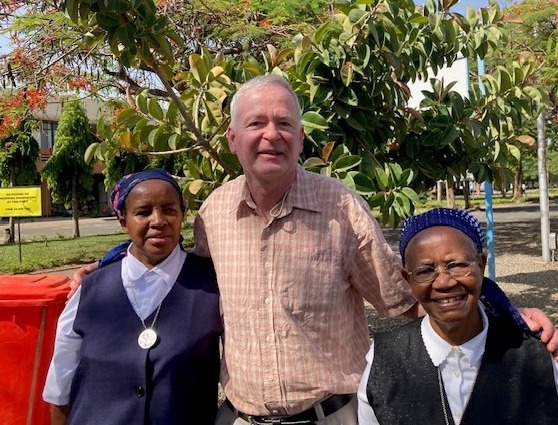 Father Kelly with Holy Spirit Sisters in Tanzania.
Along with remaining available for priestly ministry, the priest plans to have more time for music as well as another of his great joys – traveling.
He pointed out that another fulfilling and enriching aspect of his priesthood is travelling to different countries through opportunities presented to him.
“When I was a seminarian back in 1981, Father Merle Kollasch was the vocations director and he said, ‘I think you should go to Africa this summer.’ I was just a kid off the farm who had hardly been out of the state of Iowa,” said Father Kelly, who took up the suggestion and spent six weeks in Tanzania with the late Father Jim McCormick, a priest of the diocese.
“That again opened up a whole new world of the church, mission, faith and universality of Catholicism.”
From that point on, Father Kelly enjoyed taking various trips to different parts of the world to make a pilgrimage, see various religious sites or/and experience the church culture and ministry of the area.
“I frequently travel based on the missionary priests that visit,” he said. “Almost always, the mission priest will say, ‘Father if you ever get a chance to come to my country, let me know.’ Well, what they don’t know is I’m the guy who says, ‘OK, give me your number and I’ll be there next year.’”
He has been able to stay with priests and accompany them in their daily pastoral ministries in various countries throughout the world.
“I’ve always enjoyed seeing priesthood lived out in different ways,” said Father Kelly. “It helps to give you a better perspective on faith and priesthood in general when you know there is a oneness to the church and yet there is diversity too.”
Thoughts to young men
For young men considering a vocation to the priesthood, he spoke of the value of a balanced life and taking opportunities when they present themselves.
Although not unlike other vocations in life, Father Kelly mentioned that many unique opportunities are presented to priests because of the people they meet.
“As a priest, we are automatically a brother priest not just to the ones in our diocese but any priest anywhere,” he said. “There is a brotherhood of priests that extends to the entire world.”
The opportunities extend beyond personal enrichment to include options in ministry beyond traditional parish and school ministries such as prison ministry, Hispanic ministry or retreat facilitator.
“There are opportunities galore depending on our gifts and talents that we didn’t even think about when we became a priest,” said Father Kelly. “My life has been so much more enriched and blessed than if I would have stayed at John Deere in accounting.”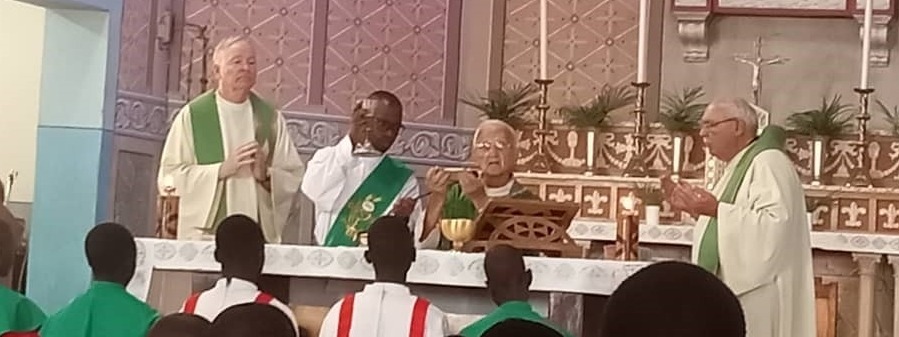 Father Kelly on left and Father Richard Ball on far right concelebrate Mass with Comboni fathers in Uganda.
Por Renee Webb
Coordinadora de contenido y diseño
Cuando el Padre Paul Kelly fue ordenado al sacerdocio en los años 1980, dijo que nunca hubiera soñado que gran parte de su ministerio estaría enfocado al ministerio de hispanohablantes.
De los 42 años en el sacerdocio, 25 de ellos han incluido el ministerio hispano. Dijo que ese aspecto de su sacerdocio ha sido no solamente un reto, pero también a traído alegría y muchas amistades.
“También abrió mi visión del mundo a la iglesia universal”, dijo Padre Kelly. “Entiendo mucho sobre la mentalidad hispana, la cultura, y la riqueza en la fe que trae consigo la cultura, especialmente la devoción a Nuestra Señora de Guadalupe.”
Él pensó en el sacerdocio durante sus años universitario en la Universidad de Iowa en Ames cuando comenzó a asistir a la misa diaria en el centro Newman. Esa práctica encendió una luz para él y surgió la idea inicial del sacerdocio.
Licenciado en administración de empresas con énfasis en contabilidad, acepto un trabajo en Deere & Company en febrero de 1977 después de graduarse un semestre antes de lo previsto. Dieciocho meses después, ingreso al seminario.
“En agosto del 1978 tome la decisión de dejar la carrera de contabilidad e ingresar al seminario. Trataría el seminario por un año para ver si me gustaba”, dijo Padre Kelly, quien se retirará en julio. “Tome esa decisión 47 años atrás, y me he mantenido con ella así que claramente fue la decisión correcta.”
Fue ordenado al sacerdocio mayo 28 de 1993 en la iglesia de San José en Sioux Rapids, la cual fue su parroquia de origen.
Actualmente Padre Kelly es el pastor de La Sagrada Familia en Emmetsburg, San Patricio en Estherville, e Inmaculada Concepción en Graettinger. Al paso de los años también ha servido en la Parroquia de la Inmaculada Concepcion en Sioux City, Parroquia de Corpus Cristi en Fort Dodge, Parroquia de San Agustín en Halbur, Santos Ángeles en Roselle, Parroquia de la Asunción en Coon Rapids, Santa Elizabeth Seton en Glidden, Catedral de la Epifanía en Sioux City, Santa Rosa de Lima en Denison, Santa Ana en Vail, Santa María en Dow City, San Bonifacio en Charte Oak, Santa María en Ute, Sagrado Corazón en Manning y Sagrado Corazón en Manilla.
“Lo que me atrajo al sacerdocio no fue la tarea escolar o el predicar, sino la misa. Sin sacerdotes, no podría tener misa,” dijo el sacerdote, quien mencionó que ya a mediados de los años 70 se hablaba de una escasez de sacerdotes. “Pensé que tenía que haber alguien que guiara a las personas en oración. El aspecto sacramental del sacerdocio- la habilidad de ofrecer la misa, enterrara los difuntos, bautizar y oficiar bodas- fue lo que mas me atrajo.”
Si bien el Padre Kelly ha ejercido su ministerio sacerdotal sirviendo como párroco, menciono que como era costumbre en el momento de su ordenación, la enseñanza en escuelas católicas fueron parte de sus asignaciones desde el principio. Al paso de los años su trabajo pastoral incluyo el ayudar en educación religiosa y el ministerio musical. Con el tiempo, las asignaciones parroquiales eran en localidades con población hispana.
Atendiendo nuevo llamado
“En 1997 el Obispo (Lawrence D.) Soens mando una carta a todos los sacerdotes describiendo la necesitad de sacerdotes para el ministerio hispano,” explico el Padre Kelly, quien menciono que siempre ha estado interesado en la misión y considero incluso convertirse en sacerdote misionero. “Cuando recibí esta carta, pensé que quizás este era el reto que yo necesitaba. En lugar de yo irme de misionero, la misión vendría a mí.”
Él fue uno de 10 a 12 sacerdotes que acordaron tomar un curso en español, de tres semanas, en San Antonio, Texas. Después de su regreso, él siguió practicando, incluso leía algunas de las lecturas de la misa en español.
“Creció a partir de eso,” dijo Padre Kelly, mencionando que antes de su primera clase solo sabía alrededor de 10 palabras en español. “Cada año yo regresaba para tomar otro curso avanzado.”
En el 2005 fue a México por cuatro meses para tomar estudios intensos y sumergirse en la cultura, ministerio parroquial y lenguaje. Fue en ese punto cuando pudo tener una conversación completa en español y dar homilías en español sin leerlo de un papel.
“Cuando fui ordenado en los 1980, nunca me hubiera imaginado que estaría diciendo misas en español y teniendo un ministerio hispano. Nunca fue algo en lo que pensé,” dijo Padre Kelly.
Él acredita al difunto Obispo Soens por tener una visión a futuro y haber sido proactivo en aminar a los sacerdotes a aprender español básico para proveer los sacramentos a los nuevos feligreses en su lengua nativa. En ese tiempo, los sacerdotes recuerdan que solo había un sacerdote activo, cual lengua nativa era español.
“La población del noroeste de Iowa ha cambiado significativamente, parte del nuevo ajuste al cambio fue aprender el lenguaje. Me di cuenta que esa fue una de las bendiciones más grandes del sacerdocio,” dijo Padre Kelly. Aporto una riqueza al sacerdocio que de otra manera hubiera perdido.”
Desafíos
Mientras que el sacerdocio le ha ofrecido innumerables bendiciones, él reconoce que también a traído desafíos.
“De alguna manera, el clérigo tiene uno de los trabajos más difíciles en el mundo- cambiar corazones y mentes,” dijo el Padre Kelly. “El cristianismo se trata sobre la conversión- conversión de nuestro ser, configuración moral, la manera que pensamos y la filosofía que sustenta la forma en la que actuamos como seres humanos.
Uno de los desafíos más grandes, señalo, es presentar el mensaje del Evangelio en una manera que resuene con las personas para que se sientan atraídas a la iglesia.
“En el noroeste de Iowa, hemos visto una disminución en la población, los sacerdotes y el número de personas que asisten a la iglesia. Todos estos han sido algo problemáticos para la diócesis, en como manejamos esto y determinamos el mejor uso de nuestros recursos” dijo. “Muchos de nuestros jóvenes no se están casando por la iglesia. Ha habido una gran decaída de cuando yo era un sacerdote joven.”
Retiro
En su retiro, el Padre Kelly planea vivir en Spencer. Como jugador aficionado de tenis, escogió esta comunidad por que ofrece un club de tenis.
Pero no pasara todo su tiempo en la cancha, “Planeo asistir a los sacerdotes de la comunidad en todo lo que pueda”.
Además de permanecer disponible para el ministerio sacerdotal, el sacerdote también planea tener más tiempo para otra de sus grandes alergias, viajar.
Señaló que otro aspecto gratificante y enriquecedor de su sacerdocio es viajar a diferentes países gracias a las oportunidades que se le presentan.
“Cuando era seminarista en 1981, el Padre Merle Kollasch era el director de vocaciones y me dijo: ‘Creo que deberías ir a África este verano’. Yo era solo un joven campesino que apenas había salido del estado de Iowa”, dijo el Padre Kelly, quien aceptó la sugerencia y pasó seis semanas en Tanzania con el difunto Padre Jim McCormick, sacerdote de la diócesis. “Eso me abrió de nuevo a un mundo completamente nuevo sobre la iglesia, la misión, la fe y la universalidad del catolicismo”.
Desde entonces, Padre Kelly a disfrutó de varios viajes a diferentes partes del mundo para peregrinar, ver varios sitios religiosos y/o experimentar la cultura y el ministerio eclesiástico de la zona.
“Frecuentemente viajo basado en los sacerdotes misioneros que visitan”, dijo. “Casi siempre, el sacerdote de la misión me dice: ‘Padre, si alguna vez tiene la oportunidad de venir a mi país, avíseme’. Bueno, lo que ellos no saben es que soy el tipo que dice ‘Bueno, dame tu número y estaré allí el año que viene’”.
Ha podido quedarse y acompañar a sacerdotes en sus ministerios pastorales en varios países del mundo.
"Siempre me ha gustado ver cómo se vive el sacerdocio de diferentes maneras", dijo el Padre Kelly. " Te da una mejor perspectiva de fe y del sacerdocio en general saber que hay unidad en la Iglesia y, al mismo tiempo, diversidad".
Pensamientos para los jóvenes
Para los jóvenes que están consideran una vocación al sacerdocio, él habló del valor de una vida balanceada y de aprovechar las oportunidades cuando se presentan.
Aunque similar a otras vocaciones en la vida, el Padre Kelly mencionó que los sacerdotes tienen muchas oportunidades únicas gracias a las personas que conocen.
"Como sacerdotes, somos automáticamente hermanos sacerdotes, no solo para los de nuestra diócesis, sino para cualquier sacerdote en cualquier lugar", dijo. "Hay una hermandad de sacerdotes que se extiende a todo el mundo".
Las oportunidades se extienden más allá del enriquecimiento personal e incluyen opciones en el ministerio que van más allá de los ministerios parroquiales y escolares tradicionales, como el ministerio penitenciario, el ministerio hispano o la facilitación de retiros.
"Hay muchísimas oportunidades, dependiendo de nuestros dones y talentos, que ni siquiera pensábamos cuando nos ordenamos sacerdotes", dijo el Padre Kelly. "Mi vida ha sido mucho más enriquecida y bendecida que si me hubiera quedado en John Deere, en contabilidad".