
Search
Divine Mercy Sunday spreads message of compassion, forgiveness
-
 May 2, 2025By RENEE WEBB
Content and Design Coordinator
It was St. John Paul II who called Sister Maria Faustina Kowalska “the great apostle of Divine Mercy in our time,” as her revelations of Jesus’ love and compassion inspired the Divine Mercy devotion.
Pope John Paul II had canonized St. Faustina on April 30, 2000, and declared the second Sunday of Easter to be Divine Mercy Sunday.
Several parishes in the Diocese of Sioux City observed Divine Mercy Sunday on April 27 with prayer services that usually included eucharistic adoration, confession, recitation of the Chaplet of Divine Mercy, veneration of the Divine Mercy image and a reflection.
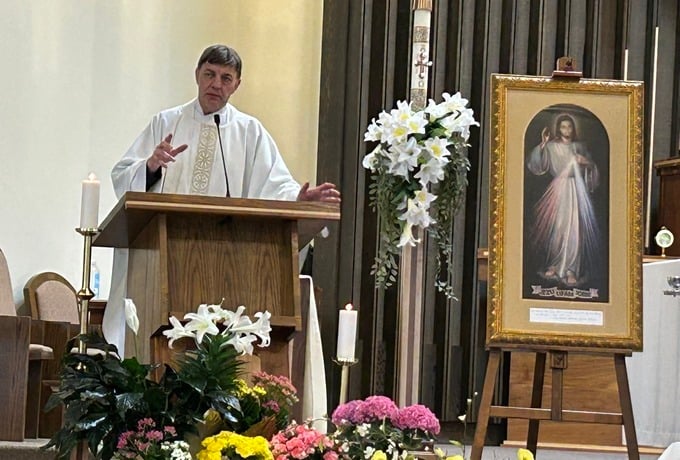
Since the official feast day was established, Trinity Heights Queen of Peace in Sioux City has been organizing a Divine Mercy Sunday celebration and this year was no exception. As has been for the last few years, the service was held at Holy Cross Parish’s St. Michael Church.
Father Randy Schon, Holy Cross pastor, offered the reflection. He spoke of young students in second grade making their first confession at about the age of 8 because that is the age to know right from wrong.
“The only bad thing is that no matter what age … we may know right from wrong but we still don’t have it perfect,” he said. “We don’t always choose right – none of us do.”
The priest pointed out that the church has a sacrament for that because God knows people will never be perfect.
Father Schon referred to a couple of popular sayings. 1) To err is human, to forgive is divine. 2) Forgive and forget.
He acknowledged that those “can be easier said than done” but that is what God calls the faithful to do and it is something practical the faithful could work on.
The priest pointed out that Divine Mercy Sunday is fairly recent in the church’s history, having been established just 25 years ago.
He shared some history of St. Faustina and mentioned that like Pope John Paul II, St. Faustina was born in Poland so the late pope was familiar with her diary and the Divine Mercy devotion. She died in 1938 at the age 33.
Tying into the theme of mercy, Father Schon noted that in the Gospel of the day Jesus told his apostles those sins you forgive are forgiven, those sins you retain are retained.
“He (Jesus) gave them the authority to forgive sins. He gave the commission of extending the mercy of God to people, even to the point of having a sacrament for it,” said Father Schon. “We celebrate God’s mercy today.”
The speaker stressed the need to extend mercy to others – something Pope Francis was known for.
Father Schon referred to some well-known parables that underscore the importance of mercy and compassion: The Good Samaritan, The Parable of the Talents and The Parable of the Lost Sheep.
“God shows compassion to the lost,” he said. “Jesus also expects us to show mercy, compassion and forgiveness to others.”
The prayer Our Father, added the speaker, also conveys that same message: Forgive us our trespasses as we forgive those who trespass against us.
“How hypocritical it would be of us to expect God to forgive us but not to extend forgiveness to others,” said Father Schon, who noted St. Faustina frequently mentioned God’s mercy extends to those “really in need of forgiveness – those who sin more. God seeks them out.”
The priest pointed out that as he has gotten older, he has gotten better at forgiving but “I still have a ways to go when it comes to forgetting and I would imagine that would be the same for a lot of us.”
Father Schon had given his reflection during the Hour of Divine Mercy that also included the Chaplet of Divine Mercy sung by Jim Doyle with excerpts from the Diary of St. Faustina offered by Debbie Organiscak. Benediction led by Deacon Fred Karpuk concluded the service.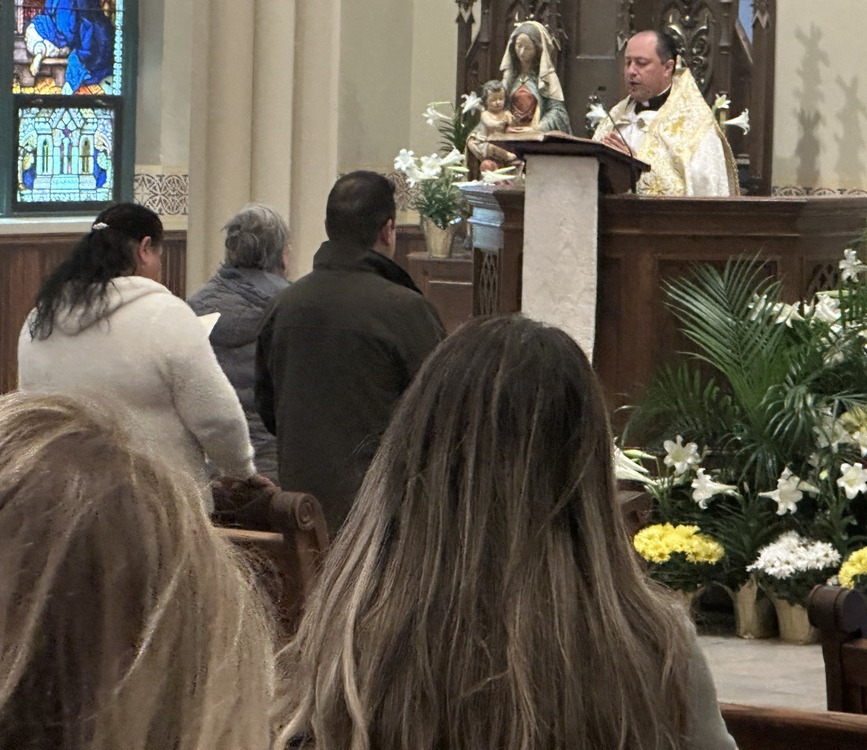 Father David Esquiliano offers a reflection at the bilingual Divine Mercy service at Cathedral of the Epiphany in Sioux City.
In the 25 years since Divine Mercy Sunday was established, several parishes have embraced the practice of having special prayer services on the day. For instance, St. Joseph Church in Wesley, which is now part of Divine Mercy Parish, is another community that has offered a special celebration for years. Once again this year the church hosted a celebration for their parish.
Cathedral of the Epiphany in Sioux City hosted a bilingual Divine Mercy Sunday celebration with Father David Esquiliano offering a homily in English and Spanish. Father Andrew Galles cantored music in Latin, English and Spanish including a bilingual Divine Mercy Chaplet.
These diocesan churches and others joined with Catholics throughout the world to obtain special graces and indulgences.