
Search
Diocesan Ministries Conference focuses on AI innovation
-
 September 26, 2025By RENEE WEBB
Content and Design Coordinator
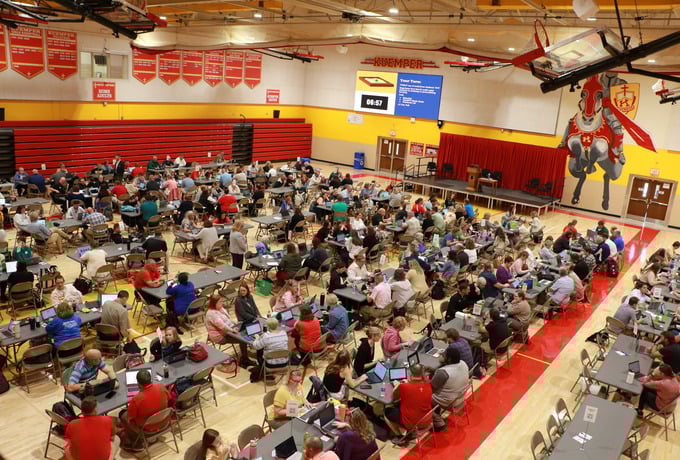
The Diocesan Ministries Conference held Sept. 22 at Kuemper High School and Holy Spirit Church in Carroll provided an opportunity for about 600 educators from all Catholic schools in the Diocese of Sioux City to come together for learning, prayer and networking.
According to Patty Lansink, diocesan superintendent of Catholic schools, the theme of the conference was Embracing Innovation and Empowering Learners. She said the overall impression of the day was extremely positive.
“We have gotten great feedback from teachers and administrators on the content,” said Lansink. “The Catholic Schools Office staff and Kuemper staff did a great job ensuring everything that day went smoothly. We were also grateful to Bishop Keehner for spending the day with us.”
This year’s biennial conference featured two keynote speakers. Father Nate Wills, CSC, who is the director of the Higher-Powered Learning Program in Notre Dame’s Alliance for Catholic Education, spoke on artificial intelligence. Doug Tooke, Catholic school principal from Montana, gave an inspirational talk focused on how educators can make a difference in the lives of their students.
The educators were asked to bring a laptop or other electronic device to use during the two hour-long workshops where they tried out various AI programs and applications. Father Wills led the workshops for grade school educators and his colleague, Lewis Poche from Notre Dame led the sessions for middle/high school educators.
AI in education
In the first keynote, Father Wills talk focused on: 1) What is generative AI? 2) What does the church say about AI? 3) What is the path going forward in using AI for the many learners in the diocese?
He stressed the fact that the number of students using AI is growing fast and there is a need for ongoing conversations about what advancements in AI means to education and how it will be applied in the classroom.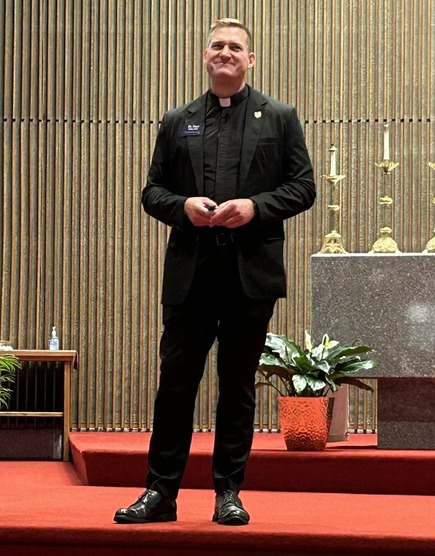 Father Nate Wills was one of two keynote speakers.“My overall message to you is don’t panic,” said Father Wills. “Catholic school educators have weathered many innovations in technology and culture including TV, calculators, the internet, Smartphones, TikTok and perhaps most egregious and dangerous is the hydro flask.” He mentioned that generative AI is different from general AI. The output is novel – won’t always have the exact output but it would be predictable and similar.
When trying to create something whether it be an image, and essay or a lesson plan using AI, Father Wills said the quality of the output does depend on input of the prompting - information/description provided.
“Generative AI is like your smart, but overconfident friend,” he cautioned. “When you ask a question in Chat GPT it will sound really confident and you assume it must be true … but that’s where you have to be a little suspicious of the output.”
The speaker pointed out that the Catholic Church has been a leader in conversations in this area, adding that the main document released on the topic is Antiqua Et Nova. The document, centered on the relationship between artificial intelligence and human intelligence, addresses AI and education in entries 77 to 84.
Father Wills said that at the G7 summit in the summer of 2024, Pope Francis referred to AI as “an exciting and fearsome tool.”
In an age when more and more young people are using chatbots for conversations, the speaker told educators they should stress to the students that chatbots are not human and information provided can be biased.
Overall, Father Wills said he is optimistic and excited about the use of generative AI by students in the classroom.
“It has the opportunity and capacity to absolutely transform studying – the work they do outside the classroom can be completely different and really powerful,” he said, adding that there is also great promise in terms of equity and access. “That is what I’m most excited about in the work you are doing with the FIRE Foundation in terms of meeting the needs of all learners.”
In terms of moving forward, he suggested that educators continue to grow in AI literacy, develop policies pertaining to AI, empower students to study using AI and engage students in the classroom through AI.
Father Wills said the use of AI can be valuable but mentioned to the educators they should explore it to determine what usage makes sense and added that they should always lead with learning goals in mind.
“We are actively working with the Vatican to create a framework for ethics in AI,” said Father Wills, adding that the framework will help educators develop a curriculum for AI use that is in alignment with the church teachings.
A living sacrifice
In the second keynote address of the day, Tooke told the educators that ultimately it is relationships that draw people into wisdom and truth. He also pointed out that a recent study showed the No. 1 characteristic in being an effective teacher was their joy.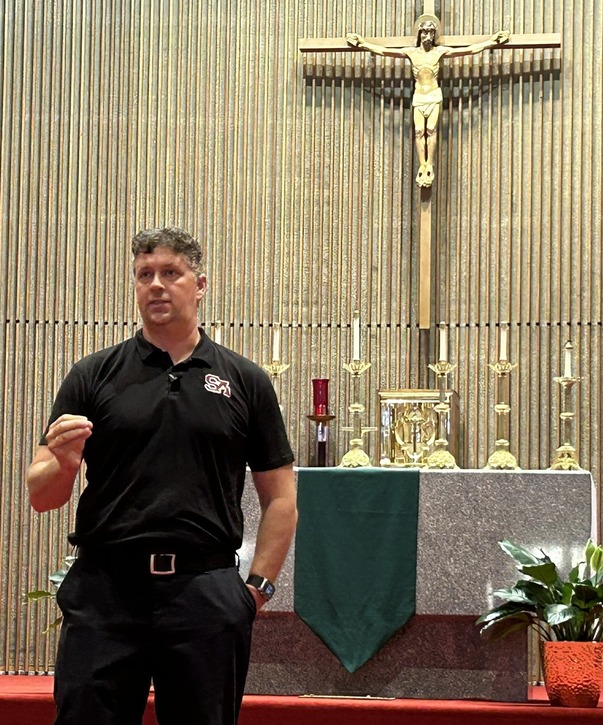 Doug Tooke presents second keynote.Reciting the Scripture verse Romans 12 – “that your life can become a living sacrifice,” the speaker said their job, their vocation was about sacrifice and making sacred the work they do. He cautioned them that if it wasn’t about that then their job “is going to be rough.”Their personal relationship with Jesus, stressed Tooke, “is indicative of your ability to draw a student into joy. I don’t care if you are teaching math. I don’t care if you are teaching science.”
He reminded them that being genuine is to know your “genesis, know where you come from.” Teaching in a Catholic school, he added, an authentic and genuine person should know that God is their creator and author of their lives.
Tooke told the educators that their ultimate purpose was “for hearts, conversion of hearts” and that is more readily accomplished when relationships have been built by teachers who provide a living sacrifice.
Reactions of attendees
Kaitlyn Steward, kindergarten teacher from St. Edmond Catholic School in Fort Dodge, said the day provided great insight into AI and how it could be utilized in the classroom and tie religion into regular subjects.
“I didn’t have a lot of prior experience with AI, so seeing how you can take a prompt from a curriculum and turn it into flash cards or a worksheet that we may not have had access to before has been fun,” she said. “Getting to see teachers from the other schools has also been nice.”
Emily Vaughan, sixth grade teacher from Spencer Sacred Heart School, said she came to the conference with some knowledge of AI having used it in her personal life.
“But it’s been nice to see how easy and simple it can make things in the classroom and come up with new ideas,” she said.
Vaughan also enjoyed hearing Tooke’s message “and pep talk” especially at the start of the school year was helpful.
Cindy Edge, principal at Pocahontas Catholic School, said there were many learning opportunities throughout the day that were both practical and creative to help her as an administrator.
“I appreciated it being intertwined with our faith to help us become stronger Catholic leaders,” she said. “I enjoyed have Doug (Tooke) back because the more I can apply his teachings to my leadership skills the better off we all are in our Catholic schools.”
Mass with bishop
Mass with Bishop John E. Keehner concluded the conference.
In his homily, he noted that the song “This Little Light of Mine” was inspired from the day’s Gospel – Luke 8:16-18.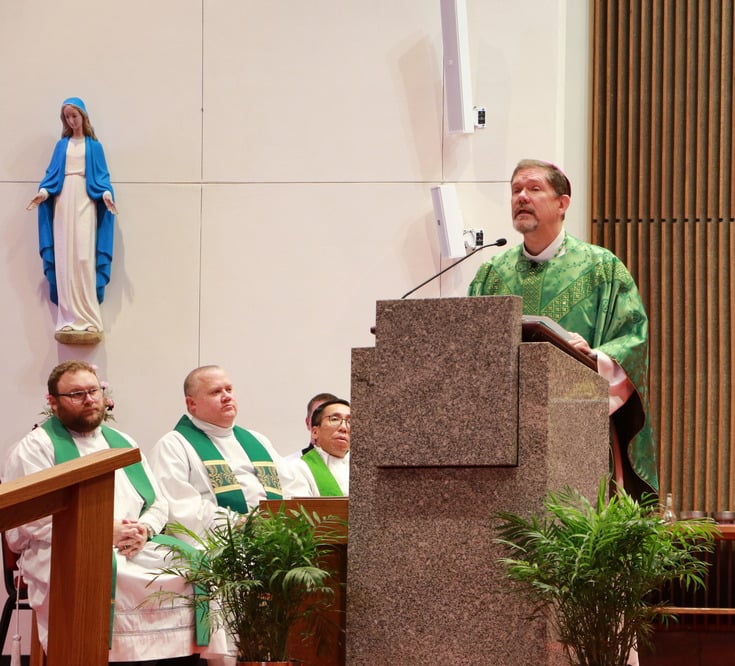 Bishop Keehner offers a homily.
A phrase from the Scripture states: “Take care, then, how you hear.”“It’s not take care what you speak, but how you hear,” said the bishop. “As a bishop, as educators, indeed as Christians, we must always take care of how we hear. We must take care that we listen to others with open minds and open hearts.”
Care must be taken, Bishop Keehner said, to listen without preconceived notions or pre-judgements so that the true meaning of the words are heard and understood. This is especially true, he added, when listening to the words of the Gospel.
“Jesus challenges us to take care of how we hear because he knows us, he knows our hearts. He knows so much of our lives are consumed with fear – fear for the future, fear for change, fear that we won’t measure up. Fear that we are going to be asked to give more and do more than we think we are able to give or do,” said the bishop.
But throughout the Gospels, Bishop Keehner noted, what Jesus says more than anything else is, “Do not be afraid.”
“In this passage in particular, he invites us to hold on to the light of his presence in our lives to outshine the darkness of our fears, outshine the darkness of our sins, to outshine whatever darkness is part of our lives so we allow him – the true light of our world – to illumine our homes, our hearts, our lives,” he said, which cannot be done if ears are closed to the Gospel message and hearts are closed to inner conversion.
Organized by the Office of Catholic Schools, several sponsors helped to make the day possible including Foundation of Northwest Iowa as the diamond sponsor, Briar Cliff University and Buena Vista University as the gold sponsors, Iowa Central Community College as the silver sponsor and Western Iowa Tech Community College as the bronze sponsor.
HOME