
Search
Clergy Day explores inclusion of persons with disabilities in parish life
-
 November 7, 2025By RENEE WEBB
Content and Design Coordinator
Words matter.
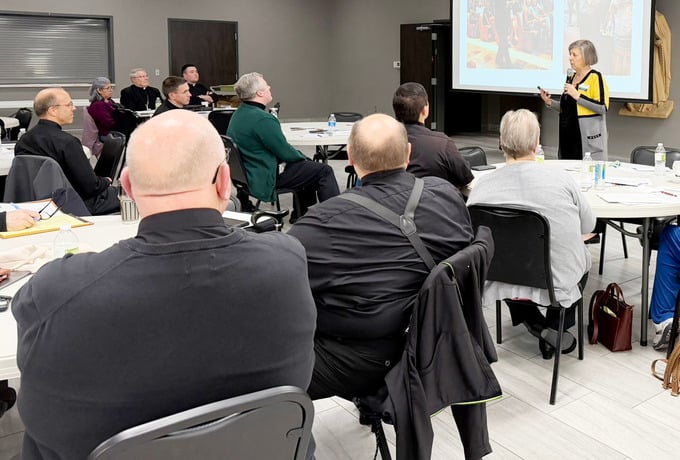
That is just one of the points made by Charleen Katra, executive director of the National Catholic Partnership on Disability (NCPD) during the Clergy Day held Nov. 6 at St. Mary Parish in Storm Lake that focused on inclusion of persons with disabilities into parish life. Due to the topic, lay catechetical leaders were also invited to attend this session.
Acknowledging that language has changed through the years – gimp, cripple, handicapped, disabled – the speaker noted it’s best to use person-first language: person with a disability. This language “represents more respectful, accurate communication. It acknowledges that people are not the disability or the diagnosis.”
She mentioned that the NCPD does have a document called Speaking of Disabilities, a pastoral guideline on language – what to say out loud or in written word for bulletins or articles. The resource is available in English and Spanish.
In the first of four talks, Katra recapped some history on this subject noting that the U.S. bishops made their first pastoral statement on ministry to persons with disabilities in 1978. This document led to the establishment of the NCPD.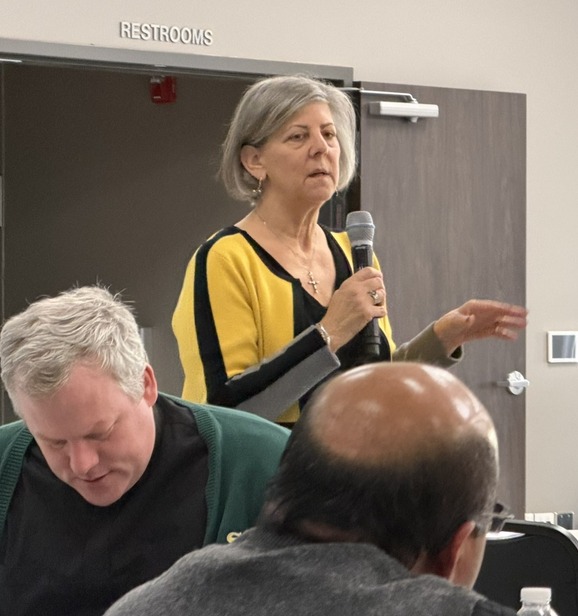 Charleen Katra, executive director of the National Catholic Partnership on Disability“That very brief document is still foundational. It has some outdated language but the document issued the challenge to the church,” she said. “It was two-fold: one is that the doors of the church need to be open to the disability community and equally or more important is the hearts of the people in the church need to be open to the disability community.”
She pointed out that what was happening at that time is a Catholic family who had a child with a disability would be welcomed for the baptism of the baby. But later, they were often turned away for the other sacraments of initiation partly due to a lack of education in this area.
This created a world of hurt feelings through the years and Katra said the bishops realized they had to do something more. That led to a second pastoral statement in 1995 – The Guidelines for the Celebration of the Sacraments with Persons with Disability, which was revised in 2017.
Baptismal rights
“We all come into the church through baptism, but through that baptism we have three baptismal rights,” said Katra, who stressed that Catholics with disabilities are no different from Catholics without. “The rights are to be educated in our faith, to be prepared to celebrate sacraments and to respond to God’s call.”
During her talks, she spoke about various resources one of which is the LAMB (language, accessibility, meaningful participation and belonging) inclusive participation assessment tool offered by the NCPD that helps to identify thriving communities that foster spiritual growth for all.
Kanta spoke about some barriers that persons with disabilities have in the churches. Given that most Catholic churches are not new builds, she cited that stairs can be a physical barrier in many locations. However, she stressed the greatest challenge is attitudinal barriers.
“The first one has cost, the second one doesn’t cost a penny so it’s more about conversion,” said the speaker.
Katra stressed that God can use a person with disabilities to change hearts.
She shared the story of a mother responding to her autistic son who asked, “Why did God make me this way?” The mother told her son, “Because God is using you to teach others about him.”
The speaker listed several statistics to demonstrate the prevalence of disabilities today.
Many impacted
“One in six children have a diagnosis of a developmental disability, one in four adults in the U.S. have some form of disability,” said Kanta, adding that disabilities include physical, intellectual, emotional and sensory.
She pointed out that one in 32 children have a diagnosis of autism today compared to 20 years ago at one in 60. Additional statistics cited were 17% of youth in the United Sates between 6-17 have experienced a mental health disorder and one in five adults experience mental illness each year.
Unfortunately, the speaker said these numbers are not often represented in the pews.
“Families don’t come because they feel the attitudinal barriers. We have to remove these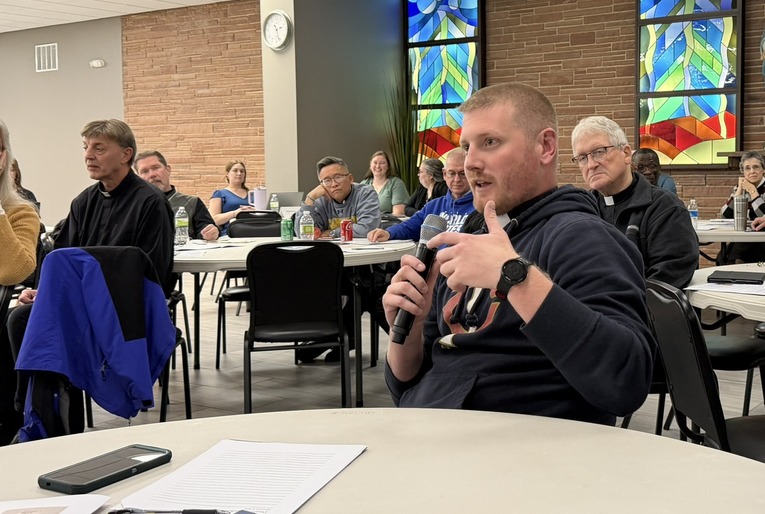 Father Zach Jones asks a question during the presentation. barriers,” said Katra. “So what can we do, practically? Give me that ambo before church to do a one-minute catechesis about the disability ministry in your parish.” She told the clergy that they set the tone, adding, “You can be the strongest link or the weakest. We have an opportunity, a lot of room to grow.”
The ministry of hospitality and evangelization, the speaker noted, is extremely important and the church must do “creative outreach” to bring many families back.
Removing barriers
Katra gave some examples of common barriers to inclusion such as parish leadership not knowing how to accommodate a person with a disability, one-dimensional learning resources, parents not disclosing diagnosis and even budgetary constraints.
The speaker gave several examples of how parishes can break down those barriers such as by designating a parish advocate to head up this ministry. She said the NCPD website offers free information and resources to help in this effort. CLICK HERE.
She also identified common discomforts/fears that may create obstacles in ministering to persons with disabilities such as not knowing how to approach them, being afraid of saying something wrong and not knowing how the person communicates.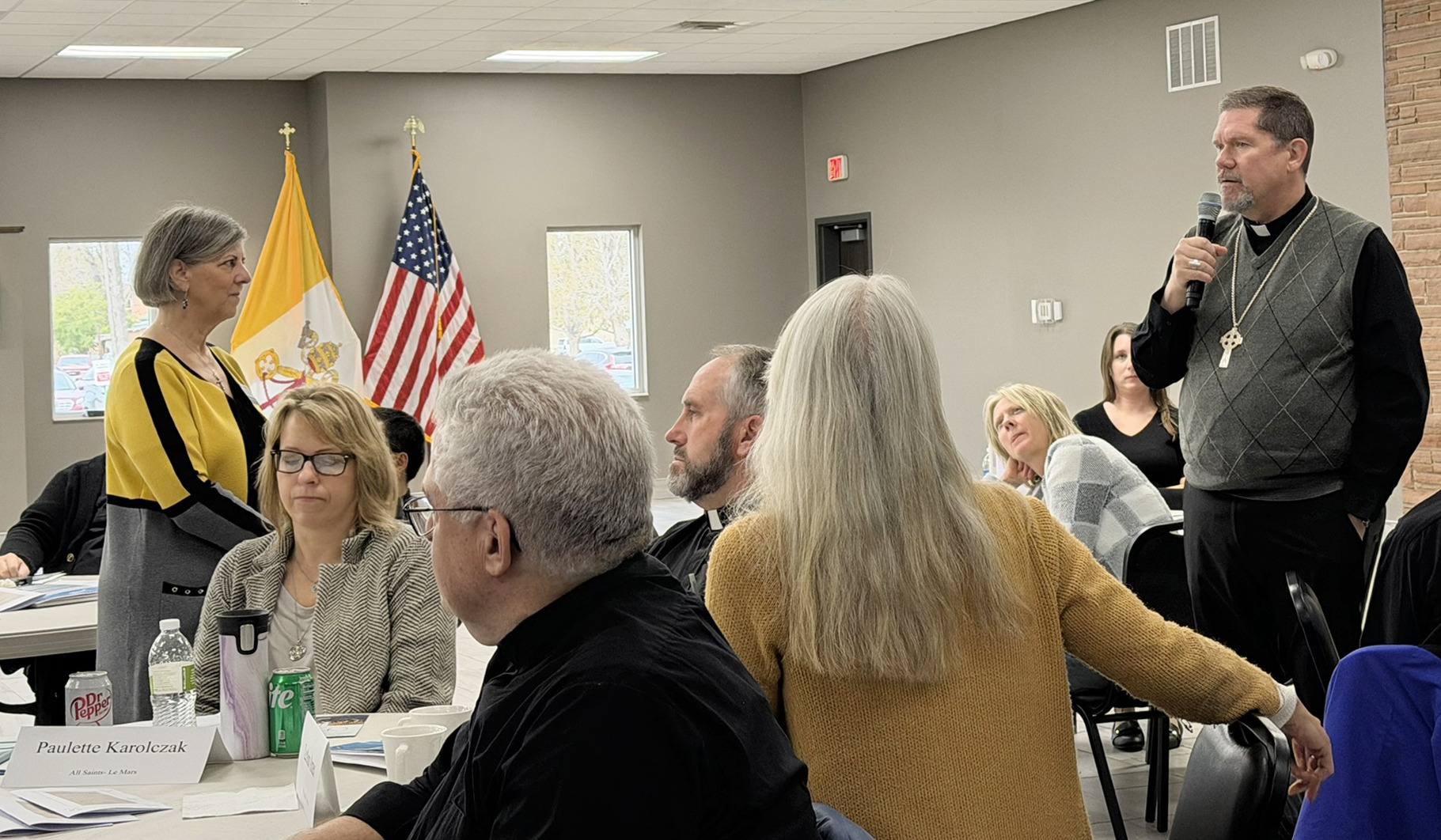 Bishop John E. Keehner shared personal experiences.Assumptions and perceptions that perpetuate harmful stigma were also discussed by Katra such as believing the person with a disability does not have the intellectual capacity to understand the concepts of the faith and are not able to receive the sacraments.
“The how-to’s, yes we can learn those. We have more resources that we have ever had before,” she said. “Training is available now more than ever before.”
In the end, the speaker said sacraments or catechesis should never be discounted due to a disability but prepare them by using “adaptive ways in the best of our ability, appropriate to that individual’s needs and abilities – and then we give them to God. God will give them the grace he wants them to have the same as he did for everyone in this room.”
Sense of belonging
As she spoke about moving from inclusivity to belonging she cited: Diversity is having a seat at the table. Inclusion is having a voice and belonging is having that voice be heard.
The 10 dimensions of belonging include to be present, invited, welcomed, known, accepted, cared for, supported, befriended, needed and loved.
“Inclusion is great but belonging is better,” stressed Katra. “You can invite me to your house for a party. You can invite me here for this day or to your parish. I can come and go but never feel or felt like I belonged in that setting.”
For catechesis to be effective, she said it has to “touch our heart. Again, it’s always about relationships.”
Families who have children with disabilities, the speaker noted, can be very isolated so building a sense of belonging and asking the question “do you need any special accommodations” can go far.
HOME